Pages

Showing posts with label Tradition/Folklore. Show all posts

20.12.15

Northumberland Christmas Traditions

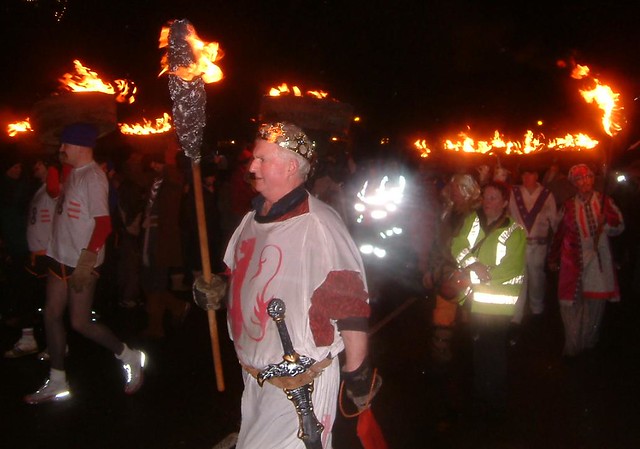
Tar barrels - Allendale

According to the BBC section of their website titled "The Ten Ages of Christmas" the modern celebrations as we know them didn't begin until the early Victorian period, with crackers, decorations, scrooge, the right jolly old elf, the Great Escape on the telly and Fenwick's window becoming the norm.

Christmas was celebrated in medieval and early-modern times but would consist of a special meal and where possible a gathering of the immediate family. The custom of Yuletide log burning was observed from Christmas Eve until 12th night on the 5th January. Surprisingly, Christmas did not consist of having decorations up from September and listening to Slade records from November 6th every year. It's unthinkable? Samuel Pepys mentions in his diaries of the late 17th century that he made a point of attending church on Christmas Day. Sometimes twice.

William Brewis a farmer of Mitford, near Morpeth, briefly mentions Christmas celebrations in his diaries kept between 1833-1850.

1834:

Sun 21st Dec: Brother James here to spend the Christmas. A very fine day with bright sun.

Thur 25th Dec: Christmas Day had all my friends to dinner the weather being so fine, they enjoyed themselves.

Fri 26th Dec: St Stevens Day Mr Mitford beagles here today running some hairs but few kills. [Hunting is frequently mentioned as Boxing Day activity. It seems to be quite a tradition.]

1839

Wed 25th Dec: Christmas Day. Expect 12 to dine. Roast Beef, Turkey, Pork, Puddings and Pidgeon pie.

In later years he mentions his two brothers and Brother-in-law spending Christmas Day with him travelling from their farms elsewhere in Northumberland.

On Christmas Day 1847 Mr Potts and son came over from Rothbury to celebrate Christmas with him, but his relationship to them is not stated.

Even in this period, however, Christmas was a relatively low-key affair in Northumberland.

As a kid growing up during the 60s and 70s in a Northumberland pit village I can remember the local colliery band performing in our street on Christmas morning. They played a carol and then moved a few yards further along, collecting a few coppers for charity along the way. It wasn't the norm though. I can only remember it happening once. It was an un-seasonably mild Christmas Day that year.

The brass band in the British style consistes of 27-29 players and is limited to specific instruments not including trumpets or French horns.

Brass bands are not unique to the North East but developed among industrial workforces in factories and mines throughout the country.

According to Wikipedia:

The modern form of the brass band in the United Kingdom dates back to the 19th century, with a vibrant tradition of competition based around local industry and communities. Most of the instruments used in British brass bands had been in use for some time in village, church and military bands, and in the 1840s and 1850s the brass band emerged from these as a popular pastime. Brass bands were a response to industrialisation, which produced a large working class population, technological advances in instrument design, and the mass production to manufacture and distribute the instruments. Many UK bands were originally either works bands, or sponsored by various industrial concerns. This was particularly evident in coal mining areas, such as the Grimethorpe Colliery Band.

The closure of heavy industries in the North East also led to the diminishing number of brass bands and their specific recorded histories. One band that has survived is the Backworth Brass Band. Their splendid website gives this bit of historical information:

Backworth Colliery Band was formed in 1886, and was part of the social element of the surrounding mine workings. The start of the band was funded in part by fundraising events such as concerts; the earliest dates to 1871. The band was originally a Wind Band (including instruments such as clarinets and flutes) but become wholly brass in the 1920s. The band rehearsed originally in the Miner’s Welfare, then across the road to Backworth Club, which served to house the band for nearly 80 years until 2004. The membership of the band has been traditionally drawn from the mining community. However as the mine works diminished, the band’s membership has changed and the band now has a membership compromising of people from many walks of life.

One tradition that is unique to the North East is the Rapper Sword Dance. The Royal Earsdon Rapper Sword Dancers have been one of the most prominent of the past dancing groups. Sword dancing has been around for a very long time but developments in metal technology which occorred during the 19th century allowed for a more flexible sword.

Wikipedia elaborates on this history:

At some stage in the nineteenth century, the rigid swords were replaced by flexible rappers. Very little is known about this major development in the tradition, due to an absence of sufficient evidence, and it may have been entirely accidental. It is commonly thought that the flexible version was used for removing dirt from the backs of pit ponies, but, there is no available documentation to verify this theory.

The dance requires five performers who co-ordinate themselves whilst using "rapper swords" made from flexible steel. Accompanied by traditional folk music, the dancers wear specially-designed shoes that allow for percussive foot movements. Mental alertness, in additional to physical agility, is required in order for dance participants to effectively utilise the swords without causing harm to themselves or the other performers. During the nineteenth century, teams of rapper dancers from the pit villages of Tyneside, and later Wearside, would travel annually to the towns of Newcastle upon Tyne, Sunderland and Durham to perform the dance for the crowds. The costume in which the dance is usually performed, referred to as the "kit", is a stylised version of the working clothes of the local nineteenth century coal miner. Some traditional teams decorated their kit with ribbons or rosettes, and added a tie and/or waistcoat.

After the Second World War, the tradition progressively declined in the original pit villages, partly as a result of social changes in the mining communities.

The Newcastle Kingmen are ensuring this tradition survives and their website is a mine of useful information and some video footage of the dance being performed.

A piece broadcast in June talked about scarecrow festivals and the midsummer eve fire ceremony at Whalton. Both have a bit of a pagan feel to them, but on investigation were found to be revived traditions and not very ancient at all.

It was of some interest, therefore, when I came across some photos of the New Years' Eve Allendale Tar Barrel celebrations on the internet. Dressed in quite sinister-looking costumes the guisers parade flaming tar barells on their heads, through the town, and then at midnight dump their barrels onto a huge bonfire in the town square. It looks like something reminiscent of the Wicker Man movie.

Was this of ancient origins? Nope! But it is still a spectacular and unique event.

The information-britain.co.uk website gives a background to the tar barrel ceremony:

The Allendale tar barrel ceremony almost certainly dates from 1858, making this magical procession a callow youth compared to many others in the country. But the sight is extraordinary, and the pride that comes with involvement is enormous.

As so often elsewhere claims of pagan roots or strange Viking ceremonies have attached to the Allendale event, but the reality is that it started when the town’s silver band parade on New Year’s Eve, normally lit by candles, took place on a night of gusty winds that made candles impractical. Some bright spark (sorry) seemingly solved the problem with barrels of lighted tar carried on the heads of the town’s strongest men. The flames were protected from the wind, the hefty barrels were stable once aloft, and a tradition was born.

The right to carry a barrel is hereditary, and the source of great pride and pleasure. The guisers wear strange uniforms of bright colours.

BBC4 broadcast a piece on this event hosted by the Unthanks. It's worth checking out...

14.5.15

Mad Meg of Meldon

Legend has it that "Mad Meg of Meldon" was once a miserly old witch who now haunts the parish which is to the west of Morpeth and Mitford.

Meldon parish is sparcely populated. Only 248 persons are resident according to 2011 census figures. The parish consists of the farming settlements of Throphill, Pigdon and Meldon. The country house and gardens of Meldon Park, now a tourist venue, also lie to the west of the parish. The house was built in 1832 by renowned architect John Dobson for new estate owners, the Cookson family. The main road from Morpeth and Mitford to Hartburn dissects the parish as does the River Wansbeck.

Location of Meldon (click to enlarge)

It was reading a tourist leaflet that Meg first came to my attention. A guided walk was being offered during the Heritage Open Days of September 2014 taking in the landmarks associated with the legend of Meg.

She has been described as: "a miser and witch from the 17th century who hoarded treasure and buried it in pits around the countryside and now haunts the old bridge at Meldon over the Wansbeck".

A visit to Meldon revealed the settlement consisted of a farmstead, church and surrounding buildings and a disused railway station which has now been converted to a dwelling house. Meldon could be described as a hamlet but the presence of a church and railway station indicates that it once had a larger population.

Meldon (click to enlarge)

However, the census statistics do not support this theory. Only 54 persons were resident in the parish in 1801. Between 1811 and 1931 the population varied between 129 and 160 persons. The large rectory which stands next to the church was only built between 1856-1894. According to the www.keystothepast.info website there were twelve houses in 1666 but then the settlement declined in size. A plan of about 1810 shows only a church, farm and a few cottages. In medieval times a tower house had stood near church. The landholders were a junior branch of the knightly family of Heron of Ford Castle. By the early 17th century the Heron family had found themselves in the position of having to mortgage the estate to the family of Selby, money lenders from Newcastle and Sir William Fenwick, owner of nearby Wallington Hall estate. The ownership of Meldon became the subject of a bitter dispute.

I was able to find out more about Meg in John Hodgson's History of Northumberland, written in the early 19th century. If Hodgson has identified the correct person from history as Meg her will is dated 2nd November 1631. This is the full piece:

MEG, or, as some call her, THE MAID OF MELDON, was, according to tradition, a person of considerable celebrity in her day as a witch and a miser ; and since her death, has continued the subject of many a winter evening's ghost tale. That she was Margaret Selby, the mother of sir Wm. Fenwick, of Meldon, is I think plain from the following circumstances. After her death, she used to go and come from Meldon by a sub- terraneous coach road to Hartington Hall, which was her residence after her husband's death. The entry into this underground way at Hartington was by a very large whinstone in the Hart, called the battling stone, from its being used to beat or battle the lie out of webs upon, in the bleaching season. Some years since, in repairing Hartington Hall, and removing a thick coat of white-wash from the walls of the most westerly room in the second story, the stucco work was found to be or- namented with family pictures, one of which some old persons remembered to have seen before it was covered, and said it was always called Meg of Meldon. Like a picture of the same lady, which was at Seaton Delaval in 1810, this was habited in a round hat with a large brim tied down at each ear, and in a stuff gown turned up nearly to the elbows, with a vandyked sleeve of linen ; the whole shoulders were covered with a thickly gathered ruff or frill. Portraits said to be of her and her husband, sir Wm. Fenwick, are preserved at Ford Castle. The traditional superstitions of the neighbourhood say that, as a retribution for her covetous disposition and practice in unearthly arts, her spirit was condemned to wander seven years and rest seven years. During the season she had to walk her nightly rounds, she was the terror of the country from Morpeth to Hartington Hall. The places of her most usual resort were those in which she had bestowed her hoarded treasure places she always abandoned after her pelf was found and turned to useful purposes. Many nights of watch- ing and penance are said to have been spent over a well a little to the south east of Meldon Tower, where she had deposited a bull's hide full of gold, which has never yet been discovered, though the present unbelieving generation can never see the phantom of its departed owner performing its vigils over it. Several large for- tunes, within the last century, are attributed to the discovery of bags of her gold. The most frequent scene of her midnight vagaries was about Meldon Bridge, along the battlements of which she was often seen run- ning in the form of a little dog. But she was Proteus- like, and appeared in a thousand forms, lights, and colours, flickering over the Wansbeck, or under a fine row of beech trees by the river side, in the lane be- tween the bridge and Meldon Park. One of her most favourite forms was that of a beautiful woman. The people of Meldon, however, became so familiarized with her appearance, as to say when she passed them, " there goes Meg of Meldon." The ceiling of Meldon school-house once gave way with the weight of a bag of her money, while the master was out at his dinner, and the varlets, who were fortunate enough to be in, and devouring the contents of their satchels at the time, had a rich scramble for it. Another of her haunts was in an ancient stone coffin on the site of Newminster Abbey, where those who had the gift of seeing ghosts, have seen her sitting in a doleful posture for many nights together. This coffin was called by the country people, the trough of the Maid of Meldon ; and water found in it, was a specific in removing warts, and curing many inveterate complaints. Such are the fables with which the calumny of an ignorant and superstitious age aspersed the character and the memory of a person, who was probably much more enlightened and virtuous than her credulous contemporaries. So bad a name may not, however, owe all its origin to the wickedness of wondering gossips. If she was, as they say, a pitiless, money-getting matron, she could not be a greater curse to the poor of her neighbourhood, than vain extrava- gant mothers are to their families. The investment of her fortune in the mortgage of Meldon, and the hard case of young Heron being forced to join in conveying the ancient seat and lands of his ancestors to her son, while they tell no good tale, either for her or the Fen- wick family, were circumstances likely enough to cause a strong popular feeling in favour of the ousted heir, and as strong a hatred to his wealthy oppressors. 
Hartington Hall is just over six miles to the North-West of Meldon.

The Monthly Chronicle of North Country Lore and Legend Vol 1 published in 1887 gives a little more detail of the reasons for Meg's miserliness:

It is said that she was one Margaret Selby, a daughter of William Selby, of Newcastle. Her father was a money-lender, and it may be that Meg inherited from him not only the fruits of life-long avarice, but the taint of avarice itself that leavened and damaged her better nature, till her name passed into a proverb for cruel greed. Her dower on marrying Sir William Fenwick,of Wallington, was a heavy mortgage on the fair estate of Meldon the fettered inheritance of young Heron. Whether she unduly pressed or unkindly foreclosed, after underhanded schemes for prevent-ing the young heir from obtaining the money for the discharge of the mortgage, none can now tell but if she did not do one or other of these things, or all three, it is not easy to account for the bad odour in which her memory was preserved of at least one brave Fenwick, who died fighting for his king two hundred and thirty years ago. 
It seems that Meg was a shrewd businesswoman of her day who prevented the Meldon estate being taken back by the Heron family who were the ancient landholders. This made her unpopular with locals.  If any of this is fact, of course. I hope that another guided tour is arranged at some time in the future. I would like to find out what truth there could be behind an underground coach road. And what has happened to the portraits that once hung in Ford Castle and Seaton Delaval Hall. Presumably the latter were destroyed in the great fire of 1822.

Link to a site with more information and images of Meldon Bridge...   http://www.bridgesonthetyne.co.uk/meldon.html


The Monthly Chronicle of North Country Lore and Legend Vol 1 published in 1887. This is the full piece:


WHO was Meg of Meldon, and wherefore was her
troubled spirit doomed to haunt the moonlit
banks of the Wansbeck? There may be little
real history, but there is much tradition and more
mystery in the legend of the miserly witch. The facts
if facts they are make but a slender skeleton on which
to hang the robes of fable.
It is said that she was one Margaret Selby, a daughter
of William Selby, of Newcastle. Her father was a
money-lender, and it may be that Meg inherited from
him not only the fruits of life-long avarice, but the taint
of avarice itself that leavened and damaged her better
nature, till her name passed into a proverb for cruel
greed. Her dower on marrying Sir William Fenwick,
of Wallington, was a heavy mortgage on the fair
estate of Meldon the fettered inheritance of young
Heron. Whether she unduly pressed or unkindly
foreclosed, after underhanded schemes for prevent-
ing the young heir from obtaining the money
for the discharge of the mortgage, none can now
tell but if she did not do one or other of these
things, or all three, it is not easy to account for the bad
odour in which her memory was preserved of at least one brave
Fenwick, who died fighting for his king two hundred and
thirty years ago. The now ruined gallery of Seaton
Delaval contained, some seventy years ago, an authentic
portrait of this famous lady. With her heavy ruff, her
vandyked sleeves, furbelowed skirts, and broad hat tied
down at the sides, over her ears, she certainly favoured
Mother Redcap and other ladies renowned for their
proficiency in magic arts.
Either she ruled while her husband reigned, or she lived
long in widowhood; for throughout the greater part of
her protracted life she must have held the purse and held
it tight. Assuming that there must be some basis for all
the stories told of her, it will be safe and fair to describe
her as exceedingly fond of money. She had a huckster-
ing, speculating, hoarding spirit. Her great hoards of
gold were never brought forth save to buy corn and beeves
in the day of plenty, to be sold at great profit in the days
of the "lean kine." At all ends she screwed out gain
from the honest poor, but they could only curse her in
their whispered prayers, for she held them tight in her
cruel grasp. Growing, buying, grinding, selling, she
sought gold and yet more gold, though its getting cost
life itself to the oppressed from whom she wrung it.
She doubtless desired to live away; but though her
barns were full and her press was groaning, and her gold
lay in heaps, she could sometimes hear the far-off mut-
terings of the voice that soon should say, "Thou fool,
this night." So she thought the more of the gold that
had cost her her soul, and, with eager cunning, plotted
that none should possess it when she should have paid
forfeit to the King of Terrors, and her strong clutch grew
lax. With magpie instinct she sought out secret places
where she could hide her treasure, and she chuckled as
she thought how men would seek in vain to grasp her
much-loved gold. She knew not that her sleep of death
would be broken with woful trouble for this same gold,
until some worthier than herself should find it and put it
to good uses. Yet this was what the story shows. Men
whispered to each other, when the burial was over, that
Meg of the Moneybags was doomed to wander in strange
shapes to and fro between the secret places of her hoards,
flitting here and there for seven long years, then resting
seven, only to begin the dreary round once more; and
this was to be her fate till all the hidden wealth was once
more passing, as wealth should ever do, in wage for
honest toil. When the wealth was once more wandering,
the poor witch's wanderings ceased for ever.
Near the south-east tower of Meldon there was a draw-
well, deep and old. In her life Meg had packed a bullock's
hide with pieces of gold and cast it into the sleeping water
of the well. So, often after death, her shadowy form was
seen now sitting, now kneeling, by the well, with arm bent
over it. as if wistfully peering into its gloomy depths, but
ever troubled as though with arduous penance and a grief
that could not be comforted. Year by year the penance
went on, but the spell was unbroken, the soul was un-
shriven. One night, in the visions of sleep, a strange
summons came to a poor hind of the Meldon lands, bid-
ding him search for the treasure in the well. He was very
poor, his heart was courageous and his conscience clear,
so he gave heed to the message. Saying never a word to
neighbour or wife, he went in the midnight to Meldon
well. There he saw a mysterious figure, and his brave
heart would have prompted him to speak, but he had been
forbidden to utter a word on pain of losing his gold. He
had brought with him chains and grappling hooks. These,
with the aid of his silent helper, were soon adjusted to the
handle and roller by which the well was usually wrought.
Fearless, he trusted himself to the chain, and passed
down and down till, to his wonder, he touched the ground,
for the water had gone. There lay the long-hidden pile
of gold, and soon the grappling irons were clutching it as
though the spirit of covetous Meg had passed into their
cold and cruel fangs. Swiftly he climbed the stretched
chain and reached the upper world. Then the twain set
to work at the wheel and axle with a will. Up came
the lunging bag of gold to the music of creaking wood
and clanging chain. When at length it came within
sight, the poor fellow, overjoyed with the thought of the
blessing he was about to call his own, forgot the in-
junction to silence, and cried exultingly, " We have her
now. " Fatal words ! The charm was gone. The dream
vanished. The hooks released their precious burden,
and down it went with a rush and a thud, sinking deep
into the slimy clay ; so deep that no mortal can ever
raise it again, or even reach it.
The poor peasant lost his boon by an untimely word of
triumph spoken at the well; and, perhaps, old Meg
bethought her that it was not kind to enjoin such hard
conditions on poor human nature. At all events, the next
disclosure she made of her secret stores was made without
conditions, and it was made to lads at school, who must
needs have lost it, every penny, had they been prohibited
from shouting aloud their boyish glee on pain of losing all
the hoard. The school-house at Meldon was old a century
ago, and the wayfarer might have imagined it haunted by
the ghosts of dead boys, who in the days gone by had
sinned and suffered beneath its moss-grown roof, or
sported in its long-drawn shadow when the day's work
was done. None ever dreamed of seeing or hearing Meg's
ghost at school any more than at church. Nor did she
walk in visible mist, or flit like marsh-fire round the
school-house yard. Yet it was one of her hiding-places.
Cunningly she had secreted pile after pile of unhallowed
gold beneath the rafters, and just above the ceiling of
the school-house. Ceilings were solid and tough in
those days, plenty of thickness, plenty of well-tempered
mortar, and plenty of cow-hair to bind the plaster
together. But scores of romping lads in each generation
had done their utmost to shake the rafters and walls
asunder. As the years went on the plaster was loosened
from its laths; and if it had hardly borne the weight of its
golden burden at first, it was every day becoming
weaker and weaker. It chanced then that the dominie
had gone in by to devour his scanty dinner. Most of the
lads were following the example of the worthy master in
this one respect so commendable in their young eyes.
A few, however, had brought their dinners with them.
These were the sons of outlying farmers and farm
labourers who had far to come for their schooling. Their
pasties, or sandwiches, or cold meat pies, with bread and
cheese to follow, were soon out of their bags and soon out
of sight in the secret cavern to which parental foresight
had destined them. Then began the romp and the riot
that were to hurry on digestion, so that they should not
sleep on their surfeit, but be ready for work or whacks
as the case might be. They chased each other over the
desks, under the desks, and round about the benches
until the old walls thrilled as if with coming ague,
and the cracked ceiling split as if in laughing sympathy
with their merry mischief. But what was that ? All
stand agape and wondering, [as a shower of dust fills
one corner of the school-house, and a sound as of
muffled thunder fills the air. They had brought the
old ceiling down with a bang. Oh, dear, whatever
would dominie say ? and, alas ! what would not dominie
do? When the crash was over and the flying lime-
dust began to settle, one bolder than the rest drew
near to see for himself the extent of the mischief done.
Hark ! he screams, but not in pain. He is down on
his knees amongst the rubbish, and stuffing the plaster
cobs into his pocket as fast as he can. "What is it?"
" Cry halves ! " " Come on, lads ! " resound through the
school-room, and then ensued a general rush. All are
now rummaging and scrambling and fighting over the
heap of dust, like lads of a later age over halfpennies
thrown out of railway trains into the mud or dust of
the street below. What is it they are striving and
riving for like a lot of eels in a basket ? It is gold
it is the boon and the bane of all the world ; gold for
which men risk their lives and barter their souls. And
shall boys be preached at because, when gold falls at their
feet, like beech leaves in autumn, they fight and struggle
and grow black in the face with the strife? And now
they rise from the crush to count their winnings. Two
or three still potter on in the heap for the chance of a
coin or two missed in the scramble ; but even they get
up in time to make safe their spoil before the master
sets foot on the scene.
Meg's spirit rests now, for all her stores save that of
Meldon Well have been found and spent for human good ;
but tradition tells how with changeful form she haunted
many a well -known spot. Meldon Bridge she was used to
cross in shape of a little dog; but when she had crossed it
either way she would assume the form of a lovely woman,
graceful and sweet, but ever sad. At times she would sit
on the great stone trough at Newminster, an ancient
coffin doubtless, and, therefore, a fit halting-place for one
who was doomed to walk this nether world in expiation
of her guilt while living. When any strange sight
attracted the notice of the passing peasant, he would say,
"There goes Meg of Meldon," whistle, and, fearless,
trudge home to tell his wife and bairns. And thus the
legend lived and grew and died away. Its basis of fact
was little more than that the lady of Meldon was an
austere dame, who knew her rights and made them good.
In doing so she may have ousted a popular young squire
for are not all ruined families the objects of romantic
sympathy on the part of the poor ? Does not misfortune'
invest their patrons with a sort of sanctity, and doei not
the gilding of success seem to them like dross when it is
made to adorn the stranger in the land ? Meg may have
brought a trading spirit into the quiet farm lands and
rustic hamlets of the Wansbeck Valley a spirit of gain-
loving and gain-getting which, though more useful, is also
less popular, than the humours of a spendthrift. And
thus the memory of one who was probably no worse than
many another of her rank has come to be blurred by the
hatred and curses of the ignorant.
Meldon Hall passed to the unfortunate Derwentwaters,
and thence through forfeiture to the Greenwich Hospital
Commissioners, from whom Isaac Cookson, alderman of
Newcastle, purchased it for the goodly sum of 56,900
guineas. There the bearers of his name emulate his
generous administration of wealth, thus effectively
redressing whatever wrong the ancient Dame of Wal-
lington inflicted on the poor. W. S.  

26.6.13

Scarecrows and Traditions

Several years ago I was travelling through the North Northumberland village of Norham. It was rather deserted at the time, except for a shadowy figure in a hooped shirt, mask and carrying a sack, scaling a ladder to an upstairs window. I did a double take and nearly crashed the car. Then I realised we were also surrounded by a completely lifeless postman and a policeman. It had a very paganish feel to it like I had just arrived on Summer Isle the fictional setting of the Whicker Man Film. They were scarecrows. Very clever, humourous and well-put-together scarecrows.

So... when I saw an advert for a scarecrow festival at Rennington, near Alnwick, last summer I had to go. I wasn't disappointed. Scarecrows lined the village streets, churchyard and almost all of the residents gardens. They were highly imaginative and often humorous. Money was being raised for good causes. So, was this all part of a centuries-old spooky, rural tradition that a pit village lad like myself really ought not to ask questions about?


No. Apparently these scarecrow festivals have only been going for about a decade or less. They are an invented or revived tradition. So, were there any ancient traditions left in Northumberland. I turned to the book by Frank Atkinson: "Life and Tradition in Northumberland and Durham" for answers. The village of Whalton, south-west of Morpeth can probably claim top spot for keeping alive traditions. Atkinson reproduces two photographs from Whalton in 1905 depicting the Baal ceremony and a Kern Baby from harvest time. Even today the villagers hold the Baal Fire Ceremony on the 4th July, which provides an excuse for some morris and barn dancing and a few drinks. Tomlinson in his "Comprehensive guide to Northumberland" first published in 1888 writes
...the villagers observed the custom, on the 4th. July (old Midsummer-eve) of kindling on the green a large bonfire, and then dancing around it and leaping through it - a relic of solar worship which has come down uninterrupted from Pagan times.
Whalton Area (click to Enlarge)

This from sacred-texts.com elaborates:
Readers of the Old Testament are well acquainted with the condemnation passed upon the worship of Baal, but some of them may be surprised to know that there is a custom in Northumberland of lighting Baal fires on St. John's Eve, which is a relic of ancient Baal worship. The identity between the celebration of the pagan rite of old and of the modern remainder is too obvious to be doubted. The ancients passed their children through the fire, and the villagers at Whalton used to jump over and through the flames... Of the Whalton custom a modern writer says:" As midsummer approaches, much wood is marked out for the bonfire, sometimes with the consent  of local farmers. When this has been cut, it is brought into the village with a certain amount of formality. On the evening of the 4th July a cart is borrowed and loaded with branches of faggots, some of the men get into the shafts, more are hooked on by means of long ropes, and then, with a good deal of shouting and horn blowing, the lumbersome vehicle is run down into the village." The same site for the fire is chosen year after year, and it has never been changed. The village turns out en masse to see the bonfire built. The children join hands and dance round the stack of wood and branches until they are tired; youths and maidens also dance a little distance away. At dark a cry is raised: "Light her!" Soon the whole village is illuminated by a huge blaze, and the Baal fire is at its height...
1905 Whalton Baal Ceremony

1905 Whalton Kern Baby


Veronica Blackett on www.whaltonvillage.co.uk writes:
The word 'bale' originated in Northumberland and was used to describe beacon fires lit on castle, pele and hill top to rouse the country when raiders were spied riding over the Border. The Morris dancers come to Whalton to entertain and the children hold hands to dance around the fire; they used to leap through the flames but this tradition has been given up... 
Harvest festivals still continue today, of course, but probably not to the same extent as in former times. Once again, Whalton had a strong tradition  in the creation of the Kern Baby.

Hutchinson writing in the 1770s in his History of Northumberland described:
In some places, an Image apparelled in great finery, crowned with flowers, a sheaf of corn placed under her arm, a scycle in her hand, carried out of the village in the morning of the conclusive reaping day, with musick and much clamour of the reapers, into the field, where it stands fixed on a pole all day, and when the reaping is done, is brought home in like manner. This they call the Harvest Queen...
What he was describing was the Kern Baby. Kern is most likely a corruption of Corn. Getting the harvest in successfully was of greater significance in past times than today with our greater use of technology and not so much of the population being engaged in rural activities. The traditions have also become more based in a church environment.

These old traditions and customs are a great way for communities to come together though. It would be nice to think they could continue.

6.5.13

The Witches of... Northumberland

Trawling through the dark recesses of my memory recently I recalled reading some time ago about a witch having been executed at Seaton Sluice. I never did get around to investigating this more fully, so today was the day.

North Berwick Witches from a contemporary pamphlet
An internet search revealed this from the Wallsend Local History Society website, which in turn is a facsimile of the Monthly Chronicle: North-Country Lore and Legend from April 1888:
We can therefore only give a plain, unvarnished, prosaic account of the affair, as it used to be told, doubtless with much more pith than we can put into it, by that extraordinary humorist and mystery-man, Sir Francis Blake Delaval.
At what definite period the witch adventure took place it is impossible now to tell. Sir Francis died in 1771, and already in his clay it was "once upon a time," and "one of the Lords of Seaton Delaval," without further specification as to when and to whom it occurred. The adventurer, whoever he was, is said to have been returning home from Newcastle after nightfall... 
The whole story is quite lengthy, but to summarise, Lord Delaval forced his way into Wallsend Church to find a bunch of "old hags" involved in a ceremony involving a naked young girl lying on a table and some knives. They fled, but Delaval managed to capture one, tie her up and transport her to Seaton Delaval. She was tried and found guilty of witchcraft. Her punishment was to be burned alive on Seaton Sluice beach. But there's more... Standing ready to be burnt at the stake she was granted a last request. To quote again:
...the witch requested to have the use of two new wooden dishes, which were forthwith procured from the neighbouring hamlet of Seaton Sluice. The combustibles were then heaped on the sands, the culprit was placed thereon, the dishes were given to her, and fire was applied to the pile. As the smoke arose in dense columns around her, she placed a foot in each of the utensils, muttered a spell, cleared herself from the fastenings at the stake, and soared away on the sea-breeze like an eagle escaped from the hands of its captors. But when she had risen to a considerable height, one of the dishes which supported her lost its efficacy from having been, by the young person who procured them, dipped unthinkingly in pure fresh water; and so, after making several gyrations, the deluded follower of Satan fell to the ground. Without affording her another chance of escape, the beholders conveyed her back to the pile, where she perished amidst its flames.
Sir Francis Blake Delaval
Now, in our enlightened times we wouldn't take this tale at face value. But could it, in fact, be based on a real event?

The 1735 Witchcraft Act, which made it illegal to accuse anybody of possessing magical powers is described in a Wikipedia article:
The law was "a heavy-handed piece of Enlightenment rationalism", designed by supporters of the new rationalist theories who believed that, contrary to popular belief at the time, "witchcraft and magic were illusory", and the law was therefore designed to "wean" the public out of a belief in them.
The peak of the witch hunts in Europe was between 1580 and the 1630s. There was "widespread hysteria that malevolent Satanic witches were operating as an organized threat to Christendom."

From the Special Collection of Newcastle University we learn:

Witch-hunters were often employed by a town council or minister when there were suspicions that witchcraft was taking place. Accusations of witchcraft were often based on limited evidence. In 1649, Newcastle upon Tyne employed a famous Scottish witch-hunter who was paid according to the number of witches he caught, meaning that it was in his best interests to find as many examples of black magic as possible. The local magistrates encouraged people to report suspicious behaviour, which provided an excellent opportunity to settle old grudges. In total, thirty women were brought to trial and twenty-seven were found guilty. The methods used to determine whether a woman was a witch were primitive and inconsistent. In the Newcastle trials a Lieutenant-Colonel Hobson expressed his doubts over the methodology used and demonstrated that the evidence was flawed:
…therefore he would try her; and presently in the sight of all the people, laid her body naked to the waist, with her clothes over her head, by which fright and shame, all her blood contracted into one part of her body, and then he ran a pin in her thigh, and then suddenly let her coats fall, and then demanded whether she had nothing of his in her body, but did not bleed, but she being amazed, replied little, then he put her aside as a guilty person, and child of the devil, and fell to try others whom he made guilty.
Lieutenant Colonel Hobson, perceiving the alteration of the foresaid woman, by her blood settling in her right parts, caused that woman to be brought again, and her clothes pulled up to her thigh, and required the Scot to run the pin into the same place, and then it gushed out of blood, and the said Scot cleared her, and said she was not a child of the devil.
In the Gateshead parish-books (1649) the following entry occurs:—"Paid at Mrs Watson's, when the Justices sat to examine the witches, 3s. 4d.: for a grave for a witch 6d.: for trying the witches £1, 5s."
"So soon as the witch finder had done in Newcastle, and received his wages, he went into Northumberland, to try women there, where he got of some three pounds a-piece; but Henry Ogle, Esq. laid hold on him, and required bond of him, to answer the sessions, but he got away for Scotland, where he was apprehended and cast into prison, indicted, arraigned, and condemned for such like villainy exercised in Scotland, and upon the gallows he confessed he had been the death of above two hundred and twenty women in England and Scotland, for the gain of twenty shillings a-piece."— Cardiner, p. 116, Newcastle Ed. of 1796.
Gardiner, in his "England's Grievance of the Coal Trade," printed in 1655, also gives a detailed account of this horrid affair.

So violent was the popular rage against these supposed wretches, who had sold themselves to the devil, that great numbers were burnt in Scotland; and in a village near Berwick, containing only fourteen houses, fourteen persons were punished by fire!
In 1590, in the Scottish village of North Berwick, the trials of more than one hundred suspected witches were held. One of the accused, Agnes Sampson was taken to Holyrood House and personally tried by the King. Under horrific torture she confessed and was executed. It is estimated from records that 3000-4000 witches were executed in Scotland between 1620 and 1680.

So did it really happen? Prior to 1604 and the passing of a witchcraft act of Parliament witches would have been tried in an ecclesiastical court of the parish church. Summary justice was often overlooked, but after this date witchcraft was tried at the Assizes which were held in Newcastle once per year by travelling judges directly accountable to the monarch. It was also common after this date for witches to be hung rather than burnt to death. A lord Delaval probably did not have the authority to carry out this death sentence unless it was perhaps at an early date. More investigation is needed on this one though...

.............................................................................................................................

Update 12 November 2012

Ann left this comment:
Very interesting indeed. A few years ago I was told that "witches" were routinely taken onto the beach at Seaton Sluice,  tied  to stakes in the sand & left to drown. Haven't been able to find anything in the history books so would be interested to see any further revelations. I was told that in "olden times" a charnal house was located roughly where Astley Gardens now stands, but again have no evidence.  
 What more could I find out about justice, punishment and Seaton Sluice in former times?

The Stewartry Museum in Kirkcudbright, Scotland holds a document listing the accounts for the execution of  Elspeth McEwen, who was executed at Silvercraigs, a hillside overlooking Kirkcudbright, on August 24th 1698. A poor and old woman, she was condemned as a witch and sentenced to be burned to death. She was the last witch to be executed in Scotland after having being found guilty at a civil trial.

This was before the Act of the Union however, and England had its own legal system. The Wikipedia article "Witch Trials in the Early Modern Period" states: 
The sentence generally was death (as Exodus 22:18 states, "Thou shalt not suffer a witch to live"). Nearly always, a witch's execution involved burning of their body. In England, witches were usually hanged before having their bodies burned and their ashes scattered. In Scotland, the witches were usually strangled at the stake before having their bodies burned—though there are several instances where they were burned alive.
A common perception regarding the execution of a witch, including mine, is of tying to a stake and being burned alive, but it seems this was not the norm. In fact, where this is the case the executions often gain some notoriety as in the case of the Belvoir Witches burned alive at Lincoln in 1617.  Campaigners are still petitioning the Government to have them pardoned. There were many different types of execution traditionally reserved for different types of crimes and different social classes. Pirates were sometimes hung in a gibbet and tied with chains at a place where the rising tide would submerge them. In the Wapping area of London there is a place known as Execution Dock where this practice was carried out. The pirate Captain William Kidd died here by this method in 1701. However, I can't find any mention of a witch being executed by this method.

Execution of William Kidd
The historian Ronald Hutton has calculated that between 300-1000 witches were executed in England and Wales. Only 228 were officially recorded.

Special places were traditionally reserved for executions and the Town Moor at Newcastle would appear to be one of these. They were often close to the gaol in which prisoners were held. However, the term gallows and gibbet can be used synonymously. It was sometimes the case where a body, after execution, was taken to a place and hung up on a gibbet. The place was sometimes in site of the crime scene, or a strategic place where the decomposing remains would act as a deterrent to passers-by. There is an example near Elsdon where a replica of Winter's Gibbet still remains as an eerie site on the hilltop. There are also many examples of fields named as Gallow's Hill on estate and tithe maps of the late 18th - early 19th centuries including one at Burradon, six miles north of Newcastle.

The story of the Seaton Sluice witch sounds like a one of mob rule and summary justice. The major landholding aristocracy had been handed powers to use capital punishment through their manorial courts during the Norman period. A huge range of offences were subject to capital punishment but at manorial level it was mostly stealing that carried this sentence. Major crimes were dealt with by justices of the peace or the central justices at the assizes.

From the 14th century until the early 17th century the unruly border area had some of its own separate laws and customs. Wardens were appointed to police and administer the area on behalf of the monarch. They had special powers to authorize capital punishment in certain circumstances. The Delavals, although a powerful family, were not wardens and could not carry out summary justice without fear of being held to account for any such actions.