Pages

Showing posts with label Mining. Show all posts

1.3.19

Burradon Miners' Trade Union Banner

Burradon Primary School is home to a Northumberland miner's banner. It is one of only about twenty still in existence from the days when the British coalfield was still thriving. Most of the existing banners have been deposited with the Woodhorn Museum near Ashington and most of these were created after 1947.

Richard Fynes in his 1873 book "The Miners of Northumberland and Durham" referred to banner having been unfurled at a demonstration associated with the 1833 miner's strike. The banners obviously have a long history but even the most professionally-manufactured ones are fragile when subjected to wind, rain, mud and being stored under a damp working-men's club stage. The earlier ones have been destroyed or discarded when beyond repair. These early banners were also replaced periodically to reflect the changing aspirations, achievements and social conditions of the miners.

Burradon's banner is now also in a poor condition being held together in places with gaffer tape. A campaign has been launched to restore it to, as much as possible, its original condition, bearing in mind a well-meaning lodge official has previously butchered it by removing the lower edge to tidy up some previous damage. It is hoped that once again the banner can be a hub for community pride and around which village activities can take place.

The banners measure about 6ft by 5ft and are coloured using bright red, blues and gold hues. They are designed to grab your attention as are the statements which are emblazoned on to the banner such as "Workers of the World Unite" and "The New Vision".

Banner Reverse
It has been forty years since Burradon Colliery closed and thirty years since the miner's strike and the mass pit closures which followed soon after. The banners played  large part in the protests and social activities in pit villages in the mid 20th century, but the meaning and significance of the banners is not as well understood in post-coalfield days. I wanted to know more about their place in mining society.

The most comprehensive study of Northumberland miner's banners is by Hazel Edwards in her 1997 book "Follow the Banner". According to Hazel the manufacture of about three quarters of the banners can be attributed to the company of George Tuthill based in London and then Chesham in Buckinghamshire after 1940, their workshops having been destroyed during the war. There were other banner makers although not so well known as Tuthill. Bainbridge of Newcastle ventured in to this  trade for a short time. Tuthill produced a catalogue of standard designs. The more elaborate ones were obviously the most expensive. Or, for an even higher price, the banners could be more bespoke. The pitman painter Oliver Kilbourn designed a banner for the Ashington group of collieries which is often held up as a great example of banner artistry. Tuthill had been a showman and had transferred some of the tradition of fairground art into his banners. They also drew upon medieval heraldic design.

The Burradon and Weetslade Colliery banner now in the care of the local school is one of the better examples of banner design and is probably from the studios of George Tuthill although it is not signed. The exact date of the banner's creation is not known but it is likely to be between the years 1947-1951. The subject of the Burradon and Weetslade union lodge banner is nationalisation which happened to the UK coal industry in 1947. One of the featured portraits is of Clement Attlee who was Labour prime minister between 1945 and 1951 - the first prime minister of a Labour majority government. The exact cost is not known but evidence from previous Tuthill catalogues and other colliery banner commissions it was probably around £3500-£4000.

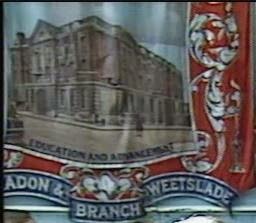
The obverse of the banner features the portraits of not only Clement Attlee, but Keir Hardie, the pioneer creator of the Independent Labour Party in 1893. Hardie was a former miner and union leader before being elected to Parliament. They were idols and figureheads to the mineworkers. Hardie's was a commonly-featured image on banners. The main central image on the Burradon and Weetslade banner is that of a miner climbing the steps to the sun with the words socialism emblazoned across it - representing the socialist utopian desire that the mineworkers had been striving for. The steps to this are labelled: nationalisation, five day week, social security, family allowances, health, peace, prosperity and happiness. These were the goals of the Labour government elected in 1945. The reverse of the banner showed a stock image of an educational building. Providing their own educational and welfare facilities had been prominent in the history of the Northumberland miners, with Burradon miners often showing a leading role in this. Burradon mineworkers had built their own school in 1860. Reading rooms, a mechanics institute, and a recreation ground soon followed. The miners appreciated the power of an educated workforce.


Nationalisation had been the long-held desire of the miners. They had for a long time campaigned that the profit of the coal owners had been put before the workers' safety. In 1935 fifteen miners were killed in the pits every four days, which was not much of an improved figure from seventy years previous. They got their desire for public ownership of the pits in 1947 following the election of a Labour Government in 1945 and many new banners were commissioned at this time to reflect this new status and the amalgamation of previous regional unions to form the National Union of Mineworkers and to celebrate the election of a Labour government.

One of the main places that you were able to see the banners unfurled was at the Northumberland Miners' Picnic. This annual gathering had been taking place since 1864. They were a mixture of recreation and political campaigning. The first picnic was reported by the Morpeth Herald in September 1864.

Morpeth Herald 10 September 1864


The mood, speeches and activities of the picnics is usually reported on in some detail in the local newspapers. After 1950 Pathe newsreels, cine film and the monthly magazine reports of the mining industry's own film unit, the Mining Review, capture the picnics and all aspects of colliery life. It can be traced through the changing banner design and tone of the speeches throughout the history of the picnics a shift in the mineworkers' attitude from a moderate, protectionist, self-help position to a one more class conscious, militant and less respectful of the directors of the coal companies.

The picnic was held at Blyth until 1872. The construction of a harbour shortened the links that the picnic had been held on. The venue then rotated at various time between Newcastle Town Moor for a brief period, Morpeth, Blyth again, Tynemouth briefly, Newbiggin briefly and then from 1952-1991 Bedlington was the picnics' home town. It still continues today although with much smaller numbers attending unsurprisingly, the venue being Woodhorn Colliery Museum.

The marching and parading was usually accompanied by a brass band. Most colliery villages had a brass band and it was an honour for a workman to to be chosen to play and represent their community.


Brass band festivals are mentioned in the local newspapers from the 1850s onwards. The Morpeth Herald carried an advert, in September 1855, for bands to register with the secretary of the Morpeth Brass Band Festival. Also in various editions of the Morpeth Herald of 1860 the Seaton Delaval Temperance Brass Band is mentioned as well as various bands of hope, but no report is given of the actual contests.

By 1869 the Morpeth Herald is sending a reporter along to describe the activities of the Morpeth Brass Festival. Eleven bands take part on this day. Burradon is not among those listed and it is not clear whether any of the competing bands belong to collieries. Some colliery bands appear in the list by 1872 however, and in 1876 Burradon Colliery Brass Band is a competitor.

Related Articles... 

The Camperdown Poisoning Case in 1856

An interesting story appeared in some of he local newspapers during 1856 which gives a fascinating glimpse into the little-regulated world of small retailers in North-East villages and of 19th century medicine.

Mrs Elizabeth Short ran a small general dealers in the mining village of Camperdown in South East Northumberland. In 1856 she stood trial before the Coroner suspected of having poisoned three children from the village.

The inquest was reported in several newspapers over the days evidence was taken. This snippet from the Newcastle Guardian of 19th April 1856 gives an account of the witness' testimonies:


Newcastle Guardian 19th April 1856

There were several other testimonies given from villagers who had purchased sulphur from Mrs Short and been violently ill, although they had eventually recovered. The report concludes with the cross-examination of Mrs Short:


Newcastle Guardian 19th April 1856

The conclusion of the inquest was reported by the Morpeth Herald on17th May 1856:


Mrs Short held the shop from 1856 until sometime after 1861. Mary Ann Bell, mentioned in the testimony to the coroner as the previous owner of the shop, was listed in the Whellan Trade Directory of 1855. In the Kelly Directory of 1858 and the census of 1861 Short was listed, although not Elizabeth Short, it was Edward Short who was named as proprietor. When Mrs Short gave evidence to the inquest she is described as being a shopkeeper, the wife of Edward Short, a labourer.

 This confusion as to who is the proprietor of the shop occurs frequently on the census returns and trade directories of the mid 19th century. Many of the publicans of the period are also listed as females, but in the case of the Grey Horse pub, which is on the same street as Elizabeth Short's shop, Christopher Wanless was the publican and also a miner. This duality of roles occurs not just in the North East but countrywide.

Location of Short's' Shop between Camperdown Inn and Travellers Rest, Property now demolished

In the case of my GG Grandfather, John Fryer, he was a long-standing and respected mining manager who then invested his considerable earnings into property, shops and pubs. He then delegated the running of these ventures to various family members. But it seems strange that a labourer, such as Edward Short, would have the capital investment to start a commercial activity of this sort. I read several of the published works on the culture of mining villages by the likes of Norman McCord, Frank Atkinson and Robert Colls but no example was given.

A case study that may be relevant and similar to Edward and Elizabeth Short's situation is that of Richard Fynes, a miner who was blacklisted from working in the collieries during the 1840s for unionist activities. He set up a business selling groceries from a cart, travelling round the local villages. After some initial struggles the business flourished and he was able to open a shop in premises in Blyth and then later in life a Theatre.

Many miners and labourers had supplemented their income through the hawking of songs and poetry or through playing and singing music if they had a talent for this.

4.9.18

18th Century Seaton Delaval Coal Mines

Aerial photos of the the undeveloped land surrounding Seaton Delaval and Hartley show cropmarks and small plantations which indicate the sites of 18th century coal pits and wagonways. The mining activities often damaged the surface and crops, or even meadow, would no longer grow at these places. There are dozens of identifiable sites although there were over 40 recorded pits in the area. These were generally of a short duration of five to ten years.

Location of some of the identifiable collieries in the Hartley district


There had been earlier, primitive, shallow bell pits further South in the Cullercoats and Whitley area which supplied coals to local salt pans, but were in decline by 1710 and the pans were sold off. The pier, which had been constructed at Cullercoats for shipping was also in need of constant attention.

Newcomen's steam, or fire engine as it was often termed, had come into general use in the Newcastle district in the 1720s. It allowed for greater depths of mines. And in the second half of the 18th century was vastly improved, with the use of cast iron in the construction, and became more powerful and larger allowing the coal North of the Briardene geological fault to be got at.

Land surrounding collieries topped with slag and coal dust. Not ideal growing conditions?


Northumberland County History: Tynemouthshire

"At this point attention may be directed to the northern portion of the district, in which there are records of coal mines about Hartley so far back as 1291. These were doubtless small outcrop pits worked for local supply, one being held by the prior and convent of Brinkburn at the time of the dissolution, and afterwards leased by the Crown to Sir Ralph Delaval in 1596. Before this time salt pans had been established at Hartley and their produce shipped at Blyth, the coal trade continuing to be a purely local one. Sir Ralph leased his mines in 1611 to Sir William Slingsby, and in 1619 to his own sons, but at the time of his death in 1628 they do not seem to have been of much account and are described as yielding no benefit to the owner.

Apparently there was little change until the latter half of the century, when Sir Ralph Delaval, the first baronet and grandson of the above mentioned Sir Ralph Delaval, took in hand the development of his property. He built a pier at Hartley Pans, or Seaton Sluice, as it was afterwards called from his having scoured the harbour by a device controlled by a sluice, and through the improvement of the harbour secured a coasting trade for the produce of his collieries and salt pans. Under his guidance and as the result of his energy the trade expanded, in spite of the fact that the Hartley coal was not so well suited for the needs of the coasting trade as that of the Tyne district. Its uses at that time may be best described in Sir Ralph's own words: the smallest will serve for lime burning and the rounder will please the cook because they make a quick fire and a constant heat.

The pits at this period were situated near the coast, to the south of Seaton Sluice, where the High Main, Yard, and Low Main seams lie at shallow depths as they rise towards the sea, and their development was attended with some difficulty, owing to the heavy feeders of water which occasionally overcame the rag and chain pumps then in use.


Sir Ralph Delaval was succeeded by his son, Sir John Delaval, and the mines were leased by him to John Rogers, one of the lessees of Whitley colliery, who with his son worked them up to 1725, when they were taken over and carried on by Sir John until his death in 1729. His successors continued to work them without any change of moment until the middle of the eighteenth century, when Sir John Hussey Delaval (afterwards Lord Delaval) became the owner of the estate and embarked on a career of enterprise of which his younger brother, Thomas Delaval, was subsequently the guiding spirit.

Glass and copperas works were established in order to utilize the small coal and brasses, or iron pyrites, from the pits, and in 1758 a fresh winning to the dip was commenced. This was followed in 1764 by the opening of the new entrance to the harbour of Seaton Sluice, cut through the solid rock to the east of the old approach, and looked upon as one of the greatest engineering feats of the day. The harbour improvements brought more trade for the pits, which in 1770 employed 300 hands, and six years later sent nearly 48,000 tons of coal away coastwise, principally to the London market, where, we are told, the Hartley coal was much esteemed by bakers.

Thomas Delaval, who was humorously described by a friend as being  busy as a bee flying from flower to flower, extracting coals from the bowels of the earth, and bottles out of damnation fiery furnaces, was equally energetic in his direction of the collieries. A new 'fire engine,' designed bv William Brown, at that time the great authority on pumping engines in the district, was set to work in 1760, and in 1763 a steam winding engine, the invention of Joseph Oxley of Ford, was erected and regarded as the greatest improvement since the introduction of the pumping engine. At this time the problem of raising coals from the deeper seams, by some quicker and more economical method than the existing horse gins, was attracting attention, and Oxley made a determined attempt to solve it.

A second engine, put down at Hartley in 1765, appears to have attracted a great deal of attention, drawing coals 'by fire' at the rate of a corf a minute for some years. It is evident, however, that it had its defects, and James Watt, who visited Hartley about 1768, described the engine as going sluggishly and irregularly, having no flywheel.

Another mechanical curiosity was a boiler built of stone and used in connection with both the winding and pumping engines. It is represented as being capable of effecting a saving of £300 a year, but most probably it did not stand the test of constant use, and, like Oxley's winding engine, was superseded by appliances of a less 'advanced' description. The double water wheel, with a pumping engine for the circulation of the water, came rapidly into favour in the district for drawing coal, and it was not until the end of the century that, through Watt's improvements, a reliable steam winding machine was produced and drove the water wheels into oblivion.

By 1780 the workings in the Yard and Low Main seams had advanced southwards to the Brierdean dyke, and as far to the dip as the level of the Engine pit. In this year the coal beyond the dyke had been opened out, and the wagonway, which can still be traced connecting the pits with Seaton Sluice, was extended southwards to the Brier Dean. After this the field lying to the west of the burn and to the dip of the old pits was entered upon, and before 1799 the Chatham and Nightingale shafts had been sunk and connected with the harbour by a branch line crossing the dean on a wooden viaduct.

Nightingale Colliery Shaft


Nightingale Shaft:
High Main Seam 90 feet
Coal 156 feet 1' 8" thick
Yard Seam 273 feet 3' 6" thick

The days of the direct control of the Delavals were now nearly at an end. Lord Delaval died in 1808. His brother and successor, Edward Hussey Delaval, continued to reside in London, and seems to have let the mines before he died in 1814.

Until towards the close of the eighteenth century, the system of working practised consisted in the removal of a portion of the coal only, the remainder being left for support. The shafts, which had originally been only a few yards apart, were gradually extended to wider distances and worked larger areas as they reached greater depths. The small pillars left were then subject to 'creeps,' caused by the crushing down of the overlying strata, more especially when, as time went on, efforts were made to minimize the loss of coal by working out portions of the pillars, a common practice before the system of leaving larger pillars and afterwards removing them entirely had been introduced."

30.6.18

Early Coal Mines

Adapted from the Northumberland County History: Earsdon and Horton.


The district surrounding Blyth possesses coal measures overlaid by boulder clay, and is a repetition of the northern portion of Tynemouthshire, to the south of this region.

Its surface is level and wind-swept, but, scenically uninteresting as it is, it forms a land well adapted for mining operations and the construction of the railways necessary for that industry. Underground, the coal seams, dipping seawards from their outcrops in the western portion of the district, are found on its eastern edge at comparatively moderate depths and are free from any serious faults or mining difficulties. Practically the whole of the seams of the North of England coalfield are met with.

Passing northwards from the Tyne, the character of the seams changes greatly, the house and gas coals of the Tyne area being replaced by the well known steam coal which forms the staple trade of the Blyth district.

To this difference in the nature of the coals the long interval separating the development of the Tyne and Blyth coalfields was due, domestic requirements affording the Tyne a widespread market many years before the introduction of steam power gave the northern district its long delayed opportunity for expansion.

The earliest record of mines in Cowpen is contained in the Tynemouth Chartulary, according to which the mines of Cowpen were held from the priory of Tynemouth by Robert, son of Alan of Cowpen, in the year 1315. [A great deal of the land at Cowpen had been granted to the various local religious organisations.] Salt pans in Cowpen were granted at the close of the twelfth century to the monks of Brinkburn. Tynemouth priory had salt pans in the same place in 1323;  and coal was, no doubt, worked in conjunction with them from upper seams lying at shallow depths near the river Blyth, on the north side of which, namely, in Bedlingtonshire, the abbey of Newminster also possessed salt pans and coal mines which they leased up to the time of the dissolution.

In 1535, the prior and convent of Tynemouth leased to Nicholas Mitford and John Preston [small landholders at Cowpen] one coal pit  with 2 picks [2 labourers]  to be wrought at the said pit in the fields of Bebside and Cowpen for seven years, and in 1538 to Richard Benson of Durham two salt pans, with the garners and housing thereto appertaining, situate on the river of Blyth in the lordship of Cowpen for forty-one years, together with half a coal pit  in the fields of Cowpen and Bebside, so long as the mine lasted, for the use of two salt pans, with wayleave and stayleave over the fields of Cowpen and Bebside.


After the dissolution of the monastery in 1539, the salt pans and coal pits were leased by the Crown to various individuals. In 1554 Thomas Bates took a lease of two salt pans and two coal pits which was renewed in 1574.  Another lease was granted in 1555 to John Preston of one coal mine with two  picks which was renewed in 1573 to Thomas Preston, his son. The lease included a covenant to serve the queen with horse and armour when required.


About this time the Percy family held property in Cowpen, formerly in possession of the Harbottles, and, in 1551, Dame Eleanor Percy leased three salt pans on the south side of the river at Cambois-ford, with coal mines for them, to Thomas Harbottle of Horton. These were subsequently leased by the Crown in 1576, after the attainder of the seventh earl of Northumberland, to Ralph Harbottle with wayleave and wood from the queen's woods for timbering the pits.


The produce of the mines seems at this period to have been almost wholly consumed in the manufacture of salt, for which the river gave an outlet to the various markets down the east coast, at Yarmouth, where it was used for herring curing, and in the Humber and elsewhere. Hartley was also a large salt-producing village at the time, shipping part of its output at Blyth. The works at Hartley were the property of Sir Robert Delaval, who, in 1576, extended his operations and became the tenant of the pans and mines at Blyth [in the vicinity of today's Commissioners Quay] formerly the property of Newminster abbey. These had been leased by the Crown after the dissolution to Richard Tyrrel of London in 1546, passing from his hands into those of Sir Thomas Grey in 1547 before they were assigned to Delaval.

[Saltworks are mentioned as early as 1201 and are located along the river for a distance opposite the mouth of the Sleekburn and Hodgson Road estate. Salt pans were used to boil and evaporate sea water leaving a deposit of salt. They were like a giant wok made of iron, although the earliest ones may have been made from lead. A structure was in place to hold the pan and contain the coal fire underneath and a shed to offer shelter. A building called a garner was used to store the salt prior to shipping. In 1736 a further six pans were constructed at Blyth by the Ridley family, having purchased them from the recently defunct Cullercoats works. Six cottages were constructed for workers so presumably a small labour force was involved in salt making. Wallace in "The History of Blyth" talking of salt manufacture in the 18th century writes "The labour in making salt was chiefly done by females. They pumped the water, wheeled the coals in barrows and shovelled the coals in firing the pans. Their wages were very small which the eked out by teasing oakem and pilfering small quantities of salt on which the duty that was levied made it of considerable value. In 1807 salt was selling for £34.10s,  £30 of which was duty. Saltworks were leased for a great deal more than a coal pit in the 16th century and previous to this time."]


The general system of leasing by the Crown appears to have consisted roughly in the allotment to each lessee of two salt pans with a coal pit, the coal lease being one of so many picks or men's work without any boundaries being set out. The lessees had the right to sink pits where they chose, with liberty of  wayleave and stayleave, the area worked by each pit being regulated by an old custom agreed upon by the farmers of the queen's coal mines, to the effect that every farmer's pitmark should be distant from one another twenty fathom sideways on each side of the pit to be sunk. These limits would include nearly one-and-a-half acres as the ground to be worked by each pit, though whether they were adhered to seems to be questionable, judging from an old plan of very little later date, from which it would appear that the shafts were irregularly placed and at smaller distances apart than those above mentioned.'


Towards the end of the sixteenth century the working of the Crown mines seems to have been almost altogether discontinued and the lessees ceased to pay rent, by reason, as it was alleged, of the 'decay of the coal mines.'


In 1595, however, a new departure was made, and in that year the Crown leased to Peter Delaval, a London merchant, already embarked in the coal trade at Preston, and Ambrose Dudley, the whole of its coal mines in the fields of Cowpen and Bebside, with nine salt pans. Opposition was made to Delaval and his partners, John Heighlord and Robert Waldo of London (the assigns of Dudley), by John Preston, a freeholder and owner of three salt pans in Cowpen, who asserted that he was the holder of a lease of two picks under the Crown, but failed to substantiate his claim in an action which he brought in 1596.


Delaval and his partners commenced to develop their property vigorously. They expended capital in sinking fresh pits and in erecting new salt pans and repairing the old ones. The pits at this period were
situated on land known as Cowpen East Field, then used as common land [each farmer being allotted strips in an open field on a periodic basis] and lately laid down from tillage under the system at that time in vogue. It may reasonably be assumed that the ground in question lay to the east of the present village of Cowpen adjoining the river, on the neighbouring banks of which it appears that four of the salt pans were placed, the remainder being probably nearer the sea.


The seam worked must have been that known locally as the  Moorland seam, which lies at a depth of about eight fathoms (48 feet) below the surface near Cowpen village, the cover increasing to about twenty fathoms in the vicinity of the Cowpen North pit. This is confirmed by the statement made in the record of the survey of the king's mines in 1621, to the effect that the pits formerly worked were eight or nine fathoms deep, the seam about seven quarters of bad quality being an open salt-pan coal. This seam produced a coarse class of coal, fitted only for salt making, and unsuited for the coasting trade in coal which was then chiefly situated on the Tyne. In 1609 the shipments of coal from Blyth amounted to only 855 tons, and it is evident that the trade of the port was then entirely dependent on the manufacture of salt, to which coal mining was subsidiary. [Tynemouth Priory was mining coal by the 14th century  on their land of Tynemouth, Preston, Chirton, Monkseaton and Earsdon where the Bensham seam outcrops. This was chiefly for landsale and salt pans which were established at Cullercoats, Hartley and Tynemouth. It was reported that a pit could be sunk to a depth of five fathoms (30 feet) in twelve days at a cost of £2.00.]


The Crown lessees encountered further opposition in their undertaking in 1599, owing to an attempt made by certain freeholders to work the coal underlying the strips, or riggs, of ground which had been held by them when the land had been in tillage. An action was consequently brought by Delaval and his partners against John Preston, Richard Preston and Cuthbert Watson, who had commenced working coal under 'riggs,' formerly occupied by themselves and other freeholders, carrying away the
produce of their pits over the Crown lands to salt pans owned by John Preston, and working the coal, as it was alleged, unskillfully and in such a way as to cause danger of water entering the mines of the queen's farmers (miners) and of the roof falling and destroying the mines. The freeholders alleged that the Crown had no right to work under their riggs except by composition with them. There is, however, no record to be found of the result of the controversy, though it seems probable that, with the exception of the Widdringtons, who had allowed the coal under their riggs to be worked by the Prestons, and whose rights were based on an alleged composition with the monastery of Tynemouth (subsequently safeguarded in the division of the lands of Cowpen in 1619), the freeholders failed to make good their claim.


Delaval was unfortunate in his ventures and failed before 1602. His partners did not continue to carry on the concern and assigned the lease to Thomas Harbottle of Horton-Stickley, who in turn appears to have handed it on to a company of capitalists from the Midlands, consisting of Sir John Ashburnham of Nottingham, Huntington Beaumont of Bilborough, near the same town, his brother-in-law Sir Henry Barkeley of Wymondham, Matthew Saunders of Shankton in Leicestershire, and Richard Paramore.


The Midland lessees seem to have been as unsuccessful as the Londoners, and were soon forced to rearrange affairs and to fall back again on London for further supplies. These were afforded by Edward Rotheram, alderman, Robert Bower and Robert Angell, merchants, of London, who were to receive 2,000 chalders of coal and the benefit of two salt pans yearly, Saunders and Paramore guaranteeing the expenditure of £2000 on the works in return for a third share of the Ashburnham, Barkeley and Beaumont interest. No better results followed the efforts of Saunders and Paramore, as, after spending 'great sums' on the salt pans and pits, they were compelled to cease operations and desert the works two years later. Their pits were situated both in Cowpen and Bebside and were connected with the river by means of wooden wagonways, apparently the earliest recorded instance of this means of conveyance, which did not come into general use in the district until considerably later on in the century. [No obvious traces of these pits now remain. But the 19th century OS mapping shows an old coal pit adjoining the river near the railway bridge.]

After Paramore and Saunders retired, their plant, both at Bebside and Cowpen, was appropriated by others. Edward Delaval of Bebside, made free with the rails set upon the land and ground of Bebside for five hundred paces on the wagonway on both sides of the way, while a similar length of way in Cowpen, together with the keels and other utensils and implements, was taken possession of by John White, Alexander Osborne and others, who entered upon the mines as farmers of the Ashburnham and Beaumont interest and occupied them for a further period of three years, when they finally ceased to be worked.


The history of the declining days of the local coal and salt industry at this period has been given in some detail as an instance of the readiness with which capital from London and the south was then generally secured in connection with north-country mines. Mining then no doubt, as it has done ever since, offered the prospect of large returns to the investor, on whom, in his ignorance of the uncertain and risky nature of the business, the much talked of successes of the few made a far deeper impression than the fate of less fortunate speculators.


William Gray, in his Chorographia published in 1649, reflects on the uncertainty of coal mining in the district and sums up his observations with the remark that colliery owning constitutes  a great charge, the profit uncertain. Neither did the south-country investor escape his attention, for he continues : "Some south gentlemen hath, upon great hope of benefit, come into this country to hazard their monies in coale-pits. Master Beaumont, a gentleman of great ingenuity and rare parts, adventured into our mines with his twenty thousand pounds; who brought with him many rare engines, not known then in these parts; as the art to bore with iron rods to try the deepness and thickness of the coal; rare engines to draw water out of the pits; waggons with one horse to carry down coals from the pits to the staithes to the river, etc. Within A few years he consumed all his money and rode home upon his light horse."


It is curious that, beyond the reference in the above well-known passage, no mention has hitherto been discovered of the doings of Beaumont in the district. That his appearance must have taken place early in the seventeenth century, or sooner, seems to be proved by the fact that the art of boring was known here as early as 1615. At that date it does not appear to have been very generally practised, mention being made in a letter written in that year by the earl of Northumberland's agent at Tynemouth of the difficulty he experienced in obtaining a borer, the only available one being in the employ of his competitors at Newcastle. The same document contains a note in the earl's handwriting with reference to boring, to the effect that "they try in Sussex for iron-mine much in the same fashion." It is evident therefore that the date at which Huntington Beaumont became one of the lessees at Cowpen corresponds with that of the probable introduction of boring into the north, and his identity with the celebrated individual of the same name seems to be further accentuated by the fact that wooden wagonways (the 'waggons with one horse to carry down coals from the pits to the staithes) were established at Cowpen and Bebside at a date which is evidently much in advance of their general introduction, a mention of wagonways in 1660 having hitherto been considered as the first distinct allusion to their use in the district.

That Huntington Beaumont was identical with Gray's unfortunate Beamont there seems to be no reason to doubt. The tradition that he gave his name to the Beaumont seam  may point to the probability of his having had mining interests elsewhere than at Cowpen, which may have accounted for a part of his supposed losses; but, on the other hand.

Gray, writing at a considerably later date, was evidently uncertain of the total, as in his corrected proofs he largely reduced the figure he had originally stated. In any case Beaumont appears to have exercised personal supervision at Cowpen, for he lived at Bebside hall, of which he is described in 1615 as having been lately the tenant with Dorothy Delaval and Edward Delaval. It was probably from that house that he set off on his 'light horse' for his home at Bilborough, a mining village near Nottingham, where he died at the age of 62 in 1623. He was a younger son of Nicholas Beaumont or Beamont, the owner of the Cole-Orton estate in Leicestershire, and, in his day, the largest coalowner in that county, as well as proprietor of an estate at Bedworth in Warwickshire on which coal was also worked. Huntington Beaumont must therefore have been brought up amongst surroundings which influenced his genius for mining. It is thought that, as his 'rare engines' practically all originated from Germany, he may have visited that country in his early days, but of this there is no record to be obtained. ( Beaumont also held a lease of coal in Bedlington in partnership with Sir Percival Willoughby, William Angell, Robert Angell, and Robert Bower. The two last named persons were likewise partners with Beaumont in the Cowpen mines.)


In the survey of the king's coal mines, made in 1621, it is mentioned with regard to Cowpen that  there are no coal pits wrought there, but notwithstanding this the Crown continued to let the coal, a lease of the mines, with four salt pans, being taken by David Errington in 1636 for twenty-one years. Errington did not make any use of his lease, and in the particulars taken by order of the Commonwealth commissioners for the sale of Crown lands in 1649, it is stated that the colliery and salt pans had been found to be a mere waste and unoccupied by Errington, who had paid no rent. The property was sold in 1650, though at the Restoration the sale was treated as invalid and the Crown resumed possession. In 1681 a lease was granted to William Urwyn for thirty-one years, a second in 1697 to Edward Hindmarsh of Little Benton for fifteen years, and a third in 1737 to Robert Douglas. A small yearly rent was reserved by these leases with the addition of one-tenth of the profits. No rent, however, was paid and no mining operations were ever undertaken.


The decay of the coal mines in the Blyth neighbourhood seems to have been general during the remainder of the seventeenth century. There is, however, some evidence of shipments having been made during this period, but the trade can only have been a very limited one, although it was of sufficient importance to procure the inclusion of Blyth, along with Newcastle and Sunderland, in an ordinance passed in 1643 prohibiting the export of coal from those ports during the Civil War.


As there is no further trace of coal having been mined at Cowpen until 1710, when Stephen Mitford appears to have been engaged in working on Mr. Sidney's [the main landholder of the western part of Cowpen] estate, it seems probable that the source from which these supplies were obtained were the small collieries which had already been established some five miles or more to the west of  Blyth in the neighbourhood of Plessey. These pits lay near to the outcrop of the lower seams, from which coal of a better quality than that hitherto found at Cowpen could be won at little depth, but, through the absence of proper means of transport, could not be carried readily to the seaboard.


Towards the close of the centurv attention seems to have been turned to these inland collieries and to Blyth as an outlet for their produce. From 1688 to 1692 was a highly speculative period in the city of London when, amongst many other joint stock companies, a 'Blyth Coal Company' was formed.

About this date the Plessey and Newsham estates were purchased by Ralph Brandling of Felling and Nathaniel Wyresdale of London, who, there is reason to believe, were acting as agents for a London company interested in securing Blyth as a convenient place for shipping the Plessey coal. Their scheme must, however, have fallen through, as not long afterwards the whole undertaking was made over to Colonel Thomas Radcliffe, who, in 1699, leased Plessey colliery to George Errington of Gray's Inn.


In 1709 Errington secured from Sir John Delaval a right of wayleave through his Horton estate for the purpose of leading coals to the river of Blyth or Blythe's Nook along the well known Plessey Wagonway, which had been constructed before his tenancy commenced, and was the means of establishing Blvth in a firm position as a coal-shipping port. The wagonwav was of the then usual wooden type, and is described in 1716 as extending over a distance of about five and a half miles, terminating in a 'large trunck or gallery to lay coals at the water side and to load ships from,' near which a quay and two salt pans had been established. The life of the wagonway was a long one, for it continued to be used as an outlet for the Plessey collieries until they were finally laid in upwards of 100 years after its formation.

Errington, in 1709, parted with his interest in the undertaking to William Bowman, a London merchant, who, with his partners, carried it on, though with such poor results that, by 1713, the control had virtually passed out of their hands into those of Lord Widdrington, already the owner of collieries at Stella and Winlaton. Operations at this time were on a very modest scale, the three small pits at work affording sufficient coal for the two salt-pans at Blyth and four others on the opposite side of the river, as well as 'ship coals' for the export trade; and, no doubt, the wagonway, with the new quay and 'trunck,' which had been built in 1715, was capable of dealing with larger quantities than the 300 tons of salt and 8,000 tons of coal which constituted the sea-borne trade of that year.


With the attainder of Lord Widdrington and Colonel Radcliffe's heirs in consequence of their share in the rising of 1715, the Plessey and Newsham estates passed to the Crown, and, in 1722, they were purchased by Richard Ridley and Company of Newcastle, who took over the working of the collieries themselves, and appear to have carried on their business with great spirit, the leadings from Plessey to Blyth amounting to about 58,000 tons in 1723.


Collieries had also been established at West Hartford about this date. The coal under this estate was purchased in 1689 by Robert Wright of Sedgefield and John Spearman of Hetton, in the county of Durham,' who in 1719 took a way leave lease over Horton from Admiral George Delaval, in which it was stipulated that they should  set apart and dowel out some convenient place on the south side of the river Blyth within the liberties of Newsham, wherein they have an estate for building staiths and wharves for the said West Hartford collieries, to be used by Admiral Delaval for the purpose of building a wharf.


Although no trace of Wright and Spearman's wagonway remains, there seems to be no reason to doubt that one was constructed and used by them for shipping coal from West Hartford, part of their plant having been bought by the Ridleys, who by 1728 had absorbed the West Hartford undertaking.


In 1730 Richard and Nicholas Ridley were carrying on an extensive business at Blyth as general merchants and colliery owners. They held command of the whole of the trade from the Plessey and Hartford collieries and had already extended the quay between the keel and boat docks, which had been built in 1715.

In 1734 the quantity of coal brought to Blyth from Plessey fell little short of 80,000 tons; of this about 2,700 tons were sent 'overseas,' the remainder being shipped coastwise, with the exception of that utilized in the manufacture of salt. The Ridleys had at this time fourteen salt pans at work, six of which had been transferred from Cullercoats in 1726, and their annual output of salt had reached 1,000 tons.'


Towards the close of the seventeenth century Bebside had again become a field for mining speculators, for in 1692 Thomas Ogle of Bedlington leased his land and collieries there to Sir Richard Neile of Plessey and John Pye of London, who covenanted not to cease working them for more than six months, 'unless hindered for want of wind to their mills and engines, or superfluity of water and styth, or a general obstruction of the coal trade.' The position of these pits is doubtful, but probably they were not far from the river, which was used by the lessees as a means of conveying the produce of the upper and poorer seams to Blyth. In 1702, Ogle sold Bebside to John Johnson, a Newcastle hostman, who presumably continued to work the mines, as, by his will made in 1727, he left his colliery at Bebside to his son-in-law, Matthew White of Blagdon, and his daughter, Mary Johnson, as tenants in common. Although mention is made of these mines at later dates, nothing is known of their subsequent working, and it may be surmised that, through lack of adequate means of transport and proper shipping facilities, they failed to make headway and so were discontinued.

2.9.16

Plessey Wagonway

It is a well-known fact that Plessey Road, stretching all the way from Blyth town centre to Newsham (2.4 miles) was laid down along the course of an old wagonway. It causes an odd appearance to what should be a gridiron layout to the streets of the town. The course of the road continues westward through Newsham fields as a modern-day footpath. There are also some earthworks remaining at Boghouses which was originally part of a wagonway bridge across the Horton Burn.

Interactive Map of Plessey Wagonway (may take a few seconds to load on some devices) or click here for larger stand-alone map


The wagonway started at Plessey Checks, a distance of five-and-a-half miles from Blyth. It has obviously had a great influence on the layout of the landscape, even up to the present day, but no obvious trace of any former industrial activity in this area would indicate why such an expensive undertaking as the construction of a wagonway was ever needed. Today it is a barren, rural area with a large roundabout at its centre. Plessey had once been a thriving coal mining area with a village of miners' cottages at its heart. What could I find out about the Plessey pits?


Earthworks at Boghouses crossing the Horton Burn


The subject had been studied by Janet Bleay for the book Plessey: The Story of a Northumbrian Woodland (1981). There is an outcrop of a very rich coal seam on the south bank of the River Blyth at Plessey. A geological fault throws this seam down 30-60 ft on the north bank where the Plessey Woods Country Park is now situated, so the early mining activity was concentrated on the south bank where the coal was more easily accessible.


Current Open-cast mining operations at Shotton and Plessey (looking east)


Mining had taken place here since medieval times, mostly by the monks of Newminster, near Morpeth, who had been granted rights of mining in the area. The operation was primitive and small scale in these early days. Drift mines were dug along the seam where it outcropped or a bell pit was sunk vertically. The bell pit was so named because it resembled the shape of a bell when seen in cross section. A small shaft was sunk down to the seam and then coal was dug out as far as was possible to go until the roof was likely to cave in or the air became too foul with suffocating gases. Coal and men were hauled up to the surface by means of a windlass with a large wicker basket attached to the rope.

When the bell pit had reached its limit you then dug another a few yards further along.


Bell Pit


Technological development meant that as time went by pits could become deeper and the coal dug further away from the shaft into the seam. The developments were: propping up the roof of the mined seam; ventilating the pit by means of lighting a furnace which used rising hot air to create a draught, air shafts were also sunk; and using engines to pump water from the workings, although in the 17th and probably even in to the late 18th centuries this would have been a horse engine in an arrangement known as a cuddy's wheel or horse gin.


Horse Gin at Beamish Museum (This file is licensed under the Creative Commons Attribution-Share Alike 4.0 International, 3.0 Unported, 2.5 Generic, 2.0 Genericand 1.0 Generic license.)


Even by 1813 when the pits ceased operation and the wagonway was ripped up the workings were not extensive. Thirteen pits were in operation in this year working by the rib and stall method. But still the extent of the workings were only tens of yards from the shaft bottom. Steam engines were by this time in common use to pump water and haul men and coal up the shaft. Deep mining had been started at Cowpen in 1794 and with the pits at Plessey being almost exhausted the owners agreed to close.

Charles Brandling was the proprietor of the mines in 1663. He was a landowner from Gosforth, near Newcastle, with extensive estates. Presumably not much coal could have been shipped via Blyth in those days? Roads were just cart tracks that became muddy during the winter season. Carts carrying coals would have soon become stuck axle deep. Long journeys were impracticable.

In 1692 the Blyth Coal Company was formed, although we know little of the organisation. Between that date and 1709 the Plessey Wagonway was laid down to allow coal wagons to run on rails. According to the Blyth News' "Story of Blyth" (1957) "The wagonway was made of a double line of beech rails laid on oak sleepers. The wagons had wooden wheels into which nails were driven to prevent wear and tear. Each wagon was pulled by one horse and driven by one man. Three journeys, or gaits, was a day's work. The first quay on this side of the river was constructed at the end of the way. There the coal was unloaded from the wagons and later loaded from barrows into the ships. This practice was continued till the building of a staith some years later." WR Sullivan in "Blyth in the Eighteenth Century" (1971) states: "As early as 1772-73 there are references to loading there from some kind of 'spout'. In 1784 we have a detailed account of expenditure on a 'staith'.

Blyth soon became established as a coal exporting port.

The Ridley family purchased the Plessey Colliery in 1722 and the following year bought the estate of Blyth. They were entrepreneurial and poured much investment into the development of the town and their business interests. In the first year they sent 58,000 tons of coal along the wagonway to Blyth. Although there was a significant domestic sale of coal most of it was sent via sea routes from Blyth.

Wagonways, however, were expensive undertakings and a major investment. In 1783 the upkeep of the Plessey Wagonway reached £1140 (roughly £230,000 in today's money) £843 the following year and £830 in 1786. Wayleave was also expensive and Lord Delaval demanded £300 per annum for the wagonway to go over his lands at Horton. Even after a series of not very friendly negotiations Ridley was not able to get this amount reduced and he proposed another, alternative, route "missing out this awkward gentleman's land altogether". The alternative route was never carried out.

Eneas MacKenzie writing in 1825 gave a statistical account of the parish of Stannington:


"For the great decrease in the population of the parish as compared with the last census of 1811, I can very satisfactorily account. About eight years ago a very extensive colliery in the South Division and townsip of Plessey was (what is technically called) laid in - that is discontinued to be worked or carried on; from which circumstances about 300 pitmen removed to the chapelry of Cowpen, where a fresh pit, or colliery, was opened, and where they continue to dwell."


The old housing was quickly removed although the old Three Horse Shoes pub and smithy buildings remained in place at Plessey Checks for quite a few decades after closure serving the Plessey New Houses to the south of the site.

Article gives useful info on NE wagonways...
http://www.dailymail.co.uk/news/article-2379064/Wooden-railway-built-200-years-ago-discovered-near-colliery.html

Related Articles...


24.4.16

Forster Memorial Homes Blyth


Tucked away from the road on a site which used to be the Cowpen Colliery is a row of modest cottages named Forster Memorial Homes. On 3rd September 1903 the Morpeth Herald reported on the opening ceremony for these cottages where many local dignitaries, including Thomas Burt MP and the secretary of the Northumberland Miner's Association, gathered to witness the handing over of keys to the first set of tenants. Ceremoniously the first door was opened with a silver key by the daughter of George Baker Forster, in who's honour the cottages were named.


The Morpeth Herald wrote:

"When the late Mr Forster passed away more than two years ago the workmen of the collieries under the Cowpen Coal Company decided unanimously to put up a memorial to their departed viewer [colliery manager, chief engineer] who had won their esteem and respect."
"The cottages are self-contained, built in no shabby way and have two rooms. There is a pretty verandah and garden in front while at the back a cemented yard is provided with water and all the necessary conveniences."


The cost of the cottages was £1250 (about £138,590 in 2015) and was raised by subscription from the workmen.

The Shield's Daily Gazette of 4th July 1901 reported on the publishing of his will. His estate was valued at £151,176, which is almost £17 million in today's money.  A memorial to him in the form of a stained glass window at a church in North Seaton, near Ashington was also being planned.

So why was George Baker Forster held in such high esteem by his workmen? Was this a rags-to-riches story? Not quite! He was born at Haswell, Co Durham on 13th October 1832 the son of Thomas Emerson Forster a well-known mining engineer and resident viewer of the colliery there. Several obituaries were printed in the newspapers at the time of his death on 18th January 1901. They seemed to be mostly based on the writings of Richard Fynes in his 1873 book "The Miners of Northumberland and Durham". Fynes was a former miner, then trader and later a theatre owner in Blyth. He remained a committed activist on the part of the mineworkers.

Champion Varsity Rower


George Baker Forster had a good education and eventually ended up at Cambridge University. He rowed bow for the university team. Rowing was a massively popular sport at the time. Large sums of money could be won. George Forster gained much kudos, which he retained throughout his life, by being a champion rower, especially after his participation the Henley Regatta of 1853. The boat races of this year are still thought to be one of the most exciting and memorable on record. The records of the records of the Christ College Cambridge Boat Club state:

"R Gordon and J B Barlee entered for the Silver Goblets at Henley, winning by 2 lengths from G B Forster and J Wright (St John's Cambridge).
"It was the remark of several Oxonians that the rowing of Mr Gordon was unsurpassed by anybody - Chitty particularly admired it."
[ Chitty was J W Chitty, stroke of the Oxford Blue Boat in 1852 and Captain. ]
The Records of Henley Royal Regatta, by H T Steward, says:
"A capital race for three quarters of a mile, when the winners gradually drew ahead and won by two lengths. Time 10 mins."
Print of Henley Regatta 1853

He had considered becoming ordained to be a clergyman but returned to his native North East where he followed in his father's footsteps and served an apprenticeship as a mining engineer, living at Cramlington Hall. He married in 1854 and the Newcastle Guardian and Tyne Mercury reported:
"The marriage of Mr. G. B. Forster, son of T. E. Forster, Esq., the eminent mining engineer, was celebrated at Seaton Delaval Colliery on Tuesday amidst every sign of rejoicing. No less than 150 flags waved from the houses and the boom of cannon was heard from morning till night, when the health of the happy couple was drank by the numerous workmen with unmistakeable fervency."
Thomas Forster was the viewer of Seaton Delaval Colliery in this period.

It was in 1858, with an apprenticeship completed, that George Baker Forster was appointed as chief viewer of Cowpen Colliery, which had recently come under new ownership. He remained the viewer until his death - a period of 42 years.

North Seaton collieries, near Ashington, were soon after amalgamated with Cowpen and Forster also developed the royalties at Cambois and Newsham with new pits. By the time of his death the output of these collieries had been raised to one million tons per annum. He became a consultant engineer, along with his father, to many other mining organisations. He also became a highly active and influential Blyth Harbour commissioner - the development of the port was essential to the growth of the local coal trade. He was Chair of the local education board and by 1880 had risen to become President of the North East Institute of Mining Engineers.

According to Fynes, writing in 1873:
"He first came prominently before the public in connection with the Hartley disaster and the part he played in endeavouring to clear the shaft not only proved him to be a man of great skill and ability but one possessing a generous sympathy with his fellow men. Since then he has often taken part in public matters connected with collieries, and has won a confidence not only of the majority of the coal owners in the district, but also in the entire body of men. [Hartley, 1862, probably the most famous mining disaster of all times when over 200 men and boys perished underground when the shaft became blocked]."

He played a prominent role in the rescue efforts at several other subsequent colliery disasters including Walker later in November of 1862. He was the Chairperson at the meetings of colliery owners following the Seaham Pit explosion of 1880. His role in these rescue efforts may have won him some respect among the ordinary workmen, but he seems to have been diplomatic and benevolent in his dealings with those of a more lowly position as illustrated by these newspaper cuttings:

"On New Year's Day, G. B. Forster, Esq., met the workmen of North Seaton Colliery, when, after a calm discussion of the change proposed to be introduced, an agreement was come to, by which the men will resume work on the footing on which they left, without reduction of becoming subject to the yearly bond. The Cowpen Collieries have not yet come to an understanding. Their notice will expire on the 16th inst., but it is hoped that before that time an amicable arrangement will be come to." [Newcastle Guardian 10th Jan 1863]
The Shields Daily Gazette said in obituary on 19th Jan 1901:
"...and he was mainly instrumental in building a place of meeting for the men at the first named colliery.
The deceased gentleman, throughout his life, took a most active part in public affairs at Blyth. He sat as one of the representatives of the coalowners upon the Blyth Harbour Commission. During his earlier days he devoted a considerable amount of his time to the general education among the working classes all through the Northumberland coal fields, and took a leading part in the establishing of mechanics' institutes at the different collieries. A further proof of his great interest in educational matters may be found in the fact that for twenty one years he sat as chairman of the Cowpen U.D. School Board, being its first chairman and holding the office continuously until six years ago. His death occurring at this period forms rather a coincidence when a new Board is being elected, almost exactly six years from the deceased gentleman s retirement.
He sat as chairman of the Blyth Bench of magistrates and for a large number of years earned a high reputation for his fair, judicial interpretation of the law. In mining affairs he was a man remarkable for conciliatory methods, and to this reason the fact is owing a large number of local, and what would have been otherwise petty disputes, were taken in hand and settled by himself instead of having recourse to the Joint Committee or Conciliation Board. He led a most active and industrious life, and a noteworthy feature in his career was his plain method of living."
On taking up the post at Cowpen Colliery in 1858 he resided at Cowpen Lodge, which was on the site of part of Morrison's supermarket. This was presumably owned by the Cowpen Colliery as Thomas Hindmarch, a manager under Forster, was later to reside there. By 1862 Forster was the resident at, the rather grand, Backworth Hall, which is about five miles south of Blyth. Backworth Hall still stands and is now a golf club clubhouse.

Morpeth Herald 1903

Related Articles...


21.3.16

Alan Carr and The Burradon Mining Disaster of 1860

One of Britains' best entertainers, Alan Carr, came to Burradon on 30th October 2011 to unveil a duplicate montage dedicated to the 1860 Mining Disaster.

This was at the invitation of the Burradon and Camperdown Forum after Alan had discovered 11 of his ancestors and relatives had perished in awful circumstances in the pit explosion. Alan was made aware of these facts while filming for the BBC programme "Who Do You Think You Are".

A montage was originally created by artist Paul Allan for the commemoration event held on 2nd March 2010. This was erected in the school, but was of limited availability for the public to see, therefore a second montage was commissioned and unveiled on Fryers Millenium Green. Photos of the event...https://goo.gl/photos/s8nM1cmEY8L1cMYc8

This is a draft copy of a magazine article on the WDYTYA? programme... https://drive.google.com/file/d/0B8uwCkN5_X3UREZZZmw5akNQbEE/view?usp=sharing

 Alan Carr WDYTYA? Magazine Article


John Carr a Victim of the Mining Disaster and his Descendants


John Carr was one of two men who had walked away from their work at Burradon Colliery about six weeks before the disaster which occurred on March 2nd 1860. He was very critical of the pit's condition, having witnessed the presence of explosive gases and vowed never to go down the pit again.

On the morning of March 2nd, the family being now almost destitute, his wife enquired of him how they were going to manage. He told her to "Lay the pit claes out", and he set off reluctantly towards the colliery and proceeded underground to start a shift. He died in the explosion.

John's son, William, later married my GG Aunt Mary Ann Fryer.

Some time ago, I received an email from a lady in Australia named Pam Abercrombie, a direct descendant of John Carr. She had read the appeal for more information on the disaster and supplied details of what happened to the Carr family, and their emigration to Australia, post 1860. Here is some of the information below:

John was born abt. 1817 and was living at West Cramlington Colliery during the time of the 1841 Census.

John married Dorothy Hughes on 30th September 1843. They were both living in Hazlerigg at the time. John's occupation on the marriage certificate is Pitman. Johns father Caleb Carr was also listed as a Pitman.

John and Dorothy were living in Downs Lane, Hetton Le Hole with their four children Samuel, William, Joseph and Elizabeth according to the 1851 Census.

1860 - According to John's death certificate he died on 3 March 1860 at Burradon Colliery aged 40yrs. Occupation Pitman. Cause of death - Explosion of gas. Information received from Stephen Reed, Coroner for Northumberland. Inquest held 3 March 1860. His death was registered 30 April 1860.

1860 - According to John's son Samuel's death certificate - Samuel Carr died 2 March 1860 at Burradon Colliery aged 15yrs. Occupation Coal Miner. Cause of death - Explosion of Gas. Informant William Kirkley, present at the death, Colliery Burradon. Samuels death was registered 18 August 1860.

1861 - John's wife Dorothy was living at 16 West Row (within?) in the village of Hazlerigg with her children, William 14, Elizabeth 10, John 8, Richard 6, Robert 4 (my great grandfather) and Ann 1. Her son Joseph was not living with the family at this time but was living with his Aunty and Uncle.

1864 - John's wife Dorothy remarried to Elijah Davis, he was also a Pitman and they were both living in Hazlerigge and in 1871 were living at Bedlington Colliery. Fortunately for the Carr family that followed, John and Dorothy's children retained the Carr surname and in fact according to following Census information 1881, 1891 Dorothy is again documented as Carr.

John's son Robert (my great grandfather), was a coal miner according to his marriage certificate and was living at Barrington Colliery in 1880.

Robert came to Australia in 1885 with his wife and young children including my grandfather John. The family settled in Newcastle NSW and Robert worked in the coal mines here (unable to cofirm which one at this time).

Robert and his family returned to Northumberland in England in 1894 and finally returned to Newcastle Australia in 1915 where the family remain today.

All of Roberts sons were coalminers here in Newcastle as were their sons. My Dad included.

On the 6 December 1925, my fathers older brother John Robert Carr lost his life at Burwood Colliery. He was only 19yrs, employed as a "Main Roads Driver". He was unharnessing a horse at the pit bottom, when the horse bolted. His hands were caught in the reins, he was dragged behind the animal and was crushed against the ribs of the colliery.

The generations which have followed have chosen not to work in the mines.

I have grown up surrounded by staunch Union supporters, both men and women, in fact my Dad's sister, great grandaughter of John Carr who died at Burradon Colliery, was a great supporter of workers rights and I can remember being dragged off the footpath by her during a protest march to join the protesters as a child. She is nearly 90yrs old now.

I would like to think that my great great grandfather John, would have been proud to know that his family has continued to speak out for the working class man as he did all those years ago.

There is so much more to know about our family history, but finding John has given us a good insight into who we are. My family have been Australians for almost
100yrs, but still feel the connection with Northumberland and still call it "The Old Country".