Showing posts with label Recreation. Show all posts

1.3.19

Burradon Miners' Trade Union Banner

Burradon Primary School is home to a Northumberland miner's banner. It is one of only about twenty still in existence from the days when the British coalfield was still thriving. Most of the existing banners have been deposited with the Woodhorn Museum near Ashington and most of these were created after 1947.

Richard Fynes in his 1873 book "The Miners of Northumberland and Durham" referred to banner having been unfurled at a demonstration associated with the 1833 miner's strike. The banners obviously have a long history but even the most professionally-manufactured ones are fragile when subjected to wind, rain, mud and being stored under a damp working-men's club stage. The earlier ones have been destroyed or discarded when beyond repair. These early banners were also replaced periodically to reflect the changing aspirations, achievements and social conditions of the miners.

Burradon's banner is now also in a poor condition being held together in places with gaffer tape. A campaign has been launched to restore it to, as much as possible, its original condition, bearing in mind a well-meaning lodge official has previously butchered it by removing the lower edge to tidy up some previous damage. It is hoped that once again the banner can be a hub for community pride and around which village activities can take place.

The banners measure about 6ft by 5ft and are coloured using bright red, blues and gold hues. They are designed to grab your attention as are the statements which are emblazoned on to the banner such as "Workers of the World Unite" and "The New Vision".

Banner Reverse
It has been forty years since Burradon Colliery closed and thirty years since the miner's strike and the mass pit closures which followed soon after. The banners played  large part in the protests and social activities in pit villages in the mid 20th century, but the meaning and significance of the banners is not as well understood in post-coalfield days. I wanted to know more about their place in mining society.

The most comprehensive study of Northumberland miner's banners is by Hazel Edwards in her 1997 book "Follow the Banner". According to Hazel the manufacture of about three quarters of the banners can be attributed to the company of George Tuthill based in London and then Chesham in Buckinghamshire after 1940, their workshops having been destroyed during the war. There were other banner makers although not so well known as Tuthill. Bainbridge of Newcastle ventured in to this  trade for a short time. Tuthill produced a catalogue of standard designs. The more elaborate ones were obviously the most expensive. Or, for an even higher price, the banners could be more bespoke. The pitman painter Oliver Kilbourn designed a banner for the Ashington group of collieries which is often held up as a great example of banner artistry. Tuthill had been a showman and had transferred some of the tradition of fairground art into his banners. They also drew upon medieval heraldic design.

The Burradon and Weetslade Colliery banner now in the care of the local school is one of the better examples of banner design and is probably from the studios of George Tuthill although it is not signed. The exact date of the banner's creation is not known but it is likely to be between the years 1947-1951. The subject of the Burradon and Weetslade union lodge banner is nationalisation which happened to the UK coal industry in 1947. One of the featured portraits is of Clement Attlee who was Labour prime minister between 1945 and 1951 - the first prime minister of a Labour majority government. The exact cost is not known but evidence from previous Tuthill catalogues and other colliery banner commissions it was probably around £3500-£4000.

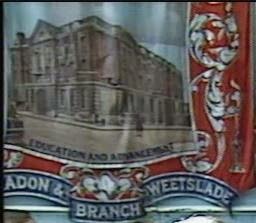
The obverse of the banner features the portraits of not only Clement Attlee, but Keir Hardie, the pioneer creator of the Independent Labour Party in 1893. Hardie was a former miner and union leader before being elected to Parliament. They were idols and figureheads to the mineworkers. Hardie's was a commonly-featured image on banners. The main central image on the Burradon and Weetslade banner is that of a miner climbing the steps to the sun with the words socialism emblazoned across it - representing the socialist utopian desire that the mineworkers had been striving for. The steps to this are labelled: nationalisation, five day week, social security, family allowances, health, peace, prosperity and happiness. These were the goals of the Labour government elected in 1945. The reverse of the banner showed a stock image of an educational building. Providing their own educational and welfare facilities had been prominent in the history of the Northumberland miners, with Burradon miners often showing a leading role in this. Burradon mineworkers had built their own school in 1860. Reading rooms, a mechanics institute, and a recreation ground soon followed. The miners appreciated the power of an educated workforce.


Nationalisation had been the long-held desire of the miners. They had for a long time campaigned that the profit of the coal owners had been put before the workers' safety. In 1935 fifteen miners were killed in the pits every four days, which was not much of an improved figure from seventy years previous. They got their desire for public ownership of the pits in 1947 following the election of a Labour Government in 1945 and many new banners were commissioned at this time to reflect this new status and the amalgamation of previous regional unions to form the National Union of Mineworkers and to celebrate the election of a Labour government.

One of the main places that you were able to see the banners unfurled was at the Northumberland Miners' Picnic. This annual gathering had been taking place since 1864. They were a mixture of recreation and political campaigning. The first picnic was reported by the Morpeth Herald in September 1864.

Morpeth Herald 10 September 1864


The mood, speeches and activities of the picnics is usually reported on in some detail in the local newspapers. After 1950 Pathe newsreels, cine film and the monthly magazine reports of the mining industry's own film unit, the Mining Review, capture the picnics and all aspects of colliery life. It can be traced through the changing banner design and tone of the speeches throughout the history of the picnics a shift in the mineworkers' attitude from a moderate, protectionist, self-help position to a one more class conscious, militant and less respectful of the directors of the coal companies.

The picnic was held at Blyth until 1872. The construction of a harbour shortened the links that the picnic had been held on. The venue then rotated at various time between Newcastle Town Moor for a brief period, Morpeth, Blyth again, Tynemouth briefly, Newbiggin briefly and then from 1952-1991 Bedlington was the picnics' home town. It still continues today although with much smaller numbers attending unsurprisingly, the venue being Woodhorn Colliery Museum.

The marching and parading was usually accompanied by a brass band. Most colliery villages had a brass band and it was an honour for a workman to to be chosen to play and represent their community.


Brass band festivals are mentioned in the local newspapers from the 1850s onwards. The Morpeth Herald carried an advert, in September 1855, for bands to register with the secretary of the Morpeth Brass Band Festival. Also in various editions of the Morpeth Herald of 1860 the Seaton Delaval Temperance Brass Band is mentioned as well as various bands of hope, but no report is given of the actual contests.

By 1869 the Morpeth Herald is sending a reporter along to describe the activities of the Morpeth Brass Festival. Eleven bands take part on this day. Burradon is not among those listed and it is not clear whether any of the competing bands belong to collieries. Some colliery bands appear in the list by 1872 however, and in 1876 Burradon Colliery Brass Band is a competitor.

Related Articles... 

23.2.15

Rowing on the River Blyth

ROWING, REGATTAS AND GAMBLING


In the edition of the Morpeth Herald of 24 September 1864 a whole column was devoted to a report on the annual Blyth Regatta. Large crowds had lined the river bank to witness a victory in the ninth race of the day for a sculling boat named "Harry Clasper".

Harry Clasper was born in 1812 at Dunston on the Tyne and died in 1870. The obvious inspiration for the naming of this boat, he was a working-class, rowing hero in the North East. He also made and developed boats. His funeral was attended by upwards of 100,000 people and even today his name is locally well known.

Rowing in the 19th century attracted a huge and fanatical following and also a great deal of money which was undoubtedly a large part of its attraction.

Blyth Rowing Club Durham Regatta Champions 1909

Clasper was not the only rowing hero. The names of Robert Chambers and James Renforth are arguably just as famous. They were the source of much local pride when taking on the crews from the Thames. Renforth even competed in New York. When he died there from the effects of performance-enhancing drugs (named Yankee Dope in the local press) The Newcastle Chronicle devoted nearly seven columns to the story. The men were feted in contemporary music hall songs by the likes of Joe Wilson and Geordie Ridley, who wrote "Blaydon Races". A decent living could be earned by a successful rower. My Great Great Uncle, Kit Barrass, was able to buy into the pub trade and had ship owning interests when he became too old to row competitively.

Rowing was the principle enthusiasm of North East sporting crowds during the later part of the 19th century. It was later eclipsed by Association Football which rapidly became popular after 1888. Newcastle United's first Division One game in 1899 attracted 20,000 spectators, with attendances rapidly increasing to 55,000 during the next decade. It is noticeable that the column inches in the Blyth newspapers devoted to aquatics diminishes rapidly after this period and is hardly mentioned at all after 1914. The sport was by this time almost completely an amateur pastime.

The River Blyth was always the little brother of the Tyne in terms of size and the quality of competitive rowing. From early in the 19th century it had been the custom to hold boat races and regattas on the Tyne. A large number of keelmen and wherrymen were employed on this river. Keel boats and wherries were narrow-draught vessels used to carry cargo from the bank down river to larger boats lying in deeper water. Keelmen held races, not only out of sporting rivalry, but for the prize money to supplement their meagre wages. The really big money, however, was in challenge races between scullers for a side stake. The races between Thames and Tyne crews were typically for between £150-200, over £20,000 at today's rate. Even local races on the Tyne could attract a prize fund of over £50, which is more than £5,000 today. Gambling also featured prominently around the rowing scene.

A smaller number of Keelmen also worked on the River Blyth. Keelmen's housing is shown near the Bedlington Iron Works and where Regent Street stands, near the market place, in the Centre of Blyth. Rowing became popular among most groups of working men however, especially miners. But the sport also attracted the interest of all sections of Blyth society from Lord Ridley downwards. By 1864 rowing had been established on the Blyth in emulation of the Tyne activities, no doubt aided by the dredging and development of the river in the previous decade.

There was a degree of snobbery associated with the early development of amateur rowing. The rural and university clubs would not compete with clubs made up of working men. They claimed labourers had an unfair advantage in terms of fitness already obtained through their occupation. This from Wikipedia:

"In 1886 the ARA issued General Rules for Regattas. The ARA adopted Henley Royal Regatta's restrictive definition of amateur which not only excluded those who made their living as professional oarsmen but also anyone who is or has been by trade or employment for wages a mechanic, artisan or labourer. Moreover, the new rules stated that only clubs affiliated to the ARA could compete in regattas held under ARA rules, and that ARA affiliated clubs could not compete under any other rules, nor against crews not affiliated to the ARA. This ruling was extremely socially divisive, effectively excluding any club with a socially mixed membership. It resulted in the formation of a breakaway organisation in 1890, the National Amateur Rowing Association, whose clubs could draw their membership from all social classes and occupations."

19TH CENTURY BLYTH AQUATICS


The regatta of 1864 mentioned in the introduction, already an annual event, featured twelve races in total. Thirty-six boats were entered in total in a diverse mix of keel, coble, sculler, four-oared boats and sailing boats. The latter turned out to be a slow and ponderous affair due to there being only the lightest breeze. The regatta was organised in connection with the Bebside and Sleekburn collieries and the Bedlington Iron Works. The location of these works is no doubt in part to do with the location of the race being from the "Straight Quay", near the railway bridge, to the Cowpen Style" some three-quarters of a mile down river. Typical prize funds were between £1.00 and £1.16s (roughly £120-170 in 2014 values). A large crowd enjoyed the fine weather and picturesque scenes along the banks of the river.

22nd July 1865: Blyth Regatta
A committee had been formed to organise this event and no connection to any works, as in the previous year, was mentioned. In fact, the regatta was headed by Commodore and judge R. Bell esq. The Commodore had a barge anchored on the river from where the Cowpen Colliery Band entertained the crowd. The barge acted as the starting point for the races. It was common for a flotilla of vessels to accompany the boats on race day. Large crowds also attended on this day encouraged by the fine weather, which once again due to lack of wind made the sailing race a farce. The races as in previous years were diverse and were for prizes just in excess of £1.00. However the main interest of the day was in the skiff handicap consisting of three heats and a final, with three boats in each heat. Michael Blakey won the first prize of £7.00 (roughly £745 in 2014). Detailed descriptions of the races and events are given by the Morpeth Herald throughout the 19th century.

11th September 1866: Whitby Boat Race
Four Blyth miners travelled to Whitby to race in cobles against a local crew of fishermen. It was for a stake of £20 (roughly £2016). They were well beaten, but admired for the fight they put up. It was a huge event in Whitby with crowds accompanying the winners at a victory parade. A whole column was devoted to this in the Morpeth Herald.


2nd November 1872: Boat Race on the Blyth for £100 (Approx £9600)
A boat race was held between two Blyth Scullers: William Williamson and James Boyd. They were team mates who had recently beaten a team from Bebside. A debate had then ensued as to who was the best of the pair and a competition was duly arranged. The "respective backers" were confident in their selection but the Morpeth Herald does not mention who the backers were. Several thousand people witnessed Williamson win comfortably but the reporter noted: "it is an impossibility to convince some Englishmen they have been thoroughly broken on the water and so there is some talk of another race being arranged for".

20th September 1873: Boat Race for £50
A usual course had by now been established between the Flanker and the Gut. Williamson was racing again, this time against Joshua Rawlins of Bebside for a stake of £50 per side. This was a return match from a race Rawlins had won in February. The Morpeth Herald article mentions many more individual skiff and sculler races having been held throughout the year. Much training had taken place in the weeks leading up to the races, with rowers being based at, and allied to, various public houses along both banks of the Blyth, such as the Brown Bar Inn - a name long-since defunct.

19th August 1875: Annual Regatta
The annual regatta was held in favourable weather attended by a crowd of thousands. The list of patrons reads as a "Who's Who" of the great and good in South East Northumberland: Lord Eslington MP, MW Ridley MP, Major Duncan RA, WB Beaumont esq MP, Major Ismay, Hugh Taylor esq, and R Wilkinson Mayor of Morpeth. A lifeboat and sailing race was held, but the main event was the skiff handicap race. This consisted of three heats of three boats and then a final heat. The prize was a "splendid" cup with £5 added.

Wednesday 6th September 1876: Annual Regatta
The annual regatta was held on a blustery day. The Morpeth Herald reporter stated: "The prize list was much more limited than in previous years. The absence of a prize for lifeboats, which was the chief feature of previous years, but, considering the limited funds at their disposal, the secretary Mr J Turnbull and his committee are to be congratulated on the interesting contests they were able to secure." Despite the lack of patronage there were still a great many races held. There is no hint, however, as to why the patronage for the event suddenly ceased.

Saturday 6th September 1884: Blyth Regatta
Morpeth Herald: "On Saturday afternoon was once more commenced a regatta on the River Blyth in the presence of a large concourse of spectators. In former years Blyth Regatta was looked forward to with a great deal of interest as nearly all the best rowers on the Tyne used to take part in the various contests, but for several years no regatta was held... A few months ago a committee was formed for the purpose of once more making an effort to re-establish it, and to a certain extent the have been successful in their efforts." Quite clearly it takes a great deal of organisation and backing to stage a regatta, which had probably not been held in the previous twelve years. It is noticeable that in the many open-boat handicaps held on the day the newspaper does not mention any prize fund. The course was over a half mile distance from the Flanker to Monkey Island.

1893: Newspaper Reports
Several individual challenge races were held between scullers in this year. The Morpeth Herald of 16th September reported on a contest between Anthony Scott and R Nicholson for £50 (£5441 2014). All of these men were local to the Blyth area. This was eclipsed, however, in a match for £100 between John Bewick and William Gibbons over the two mile Flanker to Cowpen Gut course. The MH printed: "A match of the same public interest had not taken place at Blyth since November 1887 when Charles Carr and William Gibbons were the contestants." A noticeable revival was under way in Blyth aquatic sports.

1894: Newspaper Reports
During May and June an "open-boat" handicap event was set up by the Seven Stars Pub, or North Blyth, Rowing Club, as it was alternatively known. Various publicans along the River Blyth had sponsored the event. This had probably been the case throughout the course of the last few decades. But the murky world of gambling had not been reported on much. Thomas Lee of Cowpen Square was the starter on the day and the main organiser behind the event. A former rower, although not the most successful, he would come to be the driving force of Blyth rowing for years to come. In July an accident happened to a sculler, a trimmer named Tom Forster, whilst training on the river. He capsized his boat and narrowly escaped death when he just managed to cling on to his upturned craft. A regatta was held on the Blyth in this month. Not many details are reported except that large numbers witnessed the event from paddle steamers, which was fortunate for them as the weather was inclement.

July 1896: Sailing Regatta
The annual regatta held in July of this year was a sailing race only, held in the bay and harbour, and had severed connection with the rowing clubs. The patron was the Home Secretary and principal landholder in Blyth Sir Matthew White Ridley.

FORMATION OF A BLYTH ROWING CLUB


1899: New Rowing Club at Blyth

A well-attended meeting held at the Golden Fleece public house voted to establish a rowing club. The newly-named Blyth Rowing Club had the promised support of several "influential gentlemen" although they were not named in the press. Thomas Lee was elected as Chair and de-facto secretary. Several promising scullers joined the club. The first business of the new organisation was to purchase a boathouse on the riverside.

22nd February 1902: Easter Sports at Blyth
An advert for an Easter aquatic event in Blyth appeared in the Morpeth Herald. Rowing was noted as being popular in the North at that time.

18th April 1903: Blyth Boat Racing

The 4th annual open-boat handicap for the Isaac Tucker Cup was held over the course of the Easter weekend. It was organised by the four-year-old Blyth Rowing Club. The challenge consisted of three rounds, a semi-final then the final. Thirty-two competitors entered in total. The first round consisted of sixteen heats. The rowing club had obviously managed to secure themselves a club house by this stage as the course of the race was from here to the Shearlegs. It was noted that a large crowd of spectators had attended. The sponsor, Isaac Tucker and Co Turks Head Brewery, was established at Gateshead in 1790. They had fifty tied public houses at their commercial height. The cup in this year was won by G. Davis.

Saturday 20th June 1903: International Competition
Throughout this month the Morpeth Herald devoted a great deal of column space in anticipation of an international rowing match between the four-oared team from Blyth Rowing Club, which included the holder of the Tucker Cup G. Davis, and a team from Glasgow. The paper stated that the team's preparations were going well. Arthur Jefferson, owner of the Blyth Theatre Royal and father of yet to be famous Stan Laurel was the main sponsor of the event. He had paid the travelling expenses of the Glasgow crew and provided the trophies. Blyth won the match and an awards ceremony was held that evening at the Theatre Royal. The same crew had also won the prestigious Durham Regatta earlier in the year, and would also go on to victory in 1909. The MH also wrote: "A much larger crowd had attended the event than had been seen on the Blyth for aquatics in many years".

Saturday 9th April 1904: Tucker Cup
The Morpeth Herald reported on a dissapointing Tucker challenge cup event. It was held once again over the duration of the Easter weekend and the usual half-mile course. But the weather was poor and in the opinion of the reporter so was the quality of the competitors. G. Davis failed to appear for his semi-final heat leaving C. Allen free to become the overall winner.

17th June 1905: Blyth Whitsuntide Rowing Handicap
The annual event for the Tucker Cup was moved from the Easter to the Whitsuntide weekend. This was in the hope of of more favourable weather for spectators and the ever-increasing amount of novice rowers competing in the event. The prizes were presented in August at a ceremony in the Jefferson's Theatre Royal. Mr. Fred Perry represented Isaac Tucker and Co of Gateshead. He gave a speech where he praised Blyth for having the best single sculler and best four-oared crew in the North of England, having won at various northern regattas. Blyth's club was now leading the way in North East rowing. Thomas Lee presented the accounts to the Blyth Rowing Club in December. This showed an income, and almost the same expenditure, of £11 3s raised mostly by subscriptions.

23 June 1906: Tucker Cup
A social evening of the Blyth Rowing Club was held at their headquarters, the Golden Fleece Inn, as reported by the Morpeth Herald. The Tucker Cup and medals were presented and speeches were made highlighting the many successes of the rowers over the past year with the names of the members of the Lavery and Allen families being especially singled out. Thomas Lee remarked that Blyth had a foar-oared crew to match any in the country.  Bob Balmer states in the book Images of England: Blyth that Blyth Rowing Club amalgamated with another on the river in this year.

4th April 1908: Youth Handicap
Morpeth Herald: "To encourage boat racing amongst Blyth youths a handicap is to be started on Easter Monday for youths under 18 years of age".

1st June 1909: Boat Launch
On this day the rowing club christened a new four-oared boat built by Messrs Brown of Durham. The name given was "Robert Colledge". The boat had been donated anonymously by a "lover of aquatics". It was launched as part of a town-wide event and procession which also raised money for the lifeboat and local hospital.

POST WAR


The Morpeth Herald gives very little coverage of rowing after 1914. WWI would undoubtedly have had an effect on Blyth's rowing activities, as it did other aspects of life. It does seem, however, as if rowing had become a low-key and largely amateur sport by this time.

The austerity of the 1920s and 30s also played a part in the demise of the period. Ian Wrigglesworth in his book The Social History of English Rowing comments that the 1926 General Strike "endangered the very existence of some Northern clubs such as those at Blyth and Cambois". Members of the club had been excused subscriptions until the strike ended but the lack of income must have had a detrimental effect on the club's viability. Clubs throughout the country, especially works-based clubs, had folded during the depression of the 1930s.

In 1965 the Sports Council set about encouraging a participation in rowing and gave grants of £1.00 for every £1.00 raised by a club. Cambois Rowing Club was given a Council grant which enabled it to re-locate from Blyth harbour to the River Wansbeck estuary, "leaving behind the traditionally professional Blyth Rowing Club". BRC went into economic decline and ended in 1985.

Related Articles...

4.11.13

Cinemas and Theatres of Blyth

Local newspapers have recently reported on the, soon to happen, re-opening of the old Wallaw cinema in Blyth as a JD Wetherspoon's pub. The cinema has stood empty since 2004 and it's new lease of life has been welcomed by most of Blyth's residents. The cinema is regarded as a local treasure. The art-deco style it was furnished in made it worthy of a grade II listing by English Heritage.

Wallaw Blyth

The Newcastle Journal newspaper reported the purchase of the cinema by Wetherspoons on the 29th August 2012. The writer of the article gave a brief history of the Wallaw cinema, which was also, on occasions, used as a theatre, and the development of other cinemas and places of entertainment.

The article was mostly based on the information given by English Heritage on their listings database. This describes in detail the cinema's well-loved art-deco architecture. But I was mostly interested in the history of the cinema. This is what the listing reports:
This building, which opened as a cinema in 1937, was designed by Percy Hedley Browne, Son and Harding of Newcastle upon Tyne and the job architect is believed to be Charles Alfred Harding. Research has shown that this firm and its forebears were a leading and prolific cinema practice in the north east of England. The plasterwork was by Webster Davison and Co Ltd. of Sunderland and the streamlined Moderne light fixtures are by Devereux Moody and Co Ltd of Newcastle. During the 1980s the rear of the stalls was subdivided to form two separate small auditoria. The cinema closed in 2004 with a final showing of Mel Gibson's 'The Passion of the Christ', and has remained empty since that time. The practice established by Percy Lindsay Browne in 1911 was one of the most prolific designers of cinemas to be found in the north east, and this is understood to be their best surviving work. http://list.english-heritage.org.uk/resultsingle.aspx?uid=1031569

The name "Wallaw" came from parts of the name of its owner Walter Lawson.

English Heritage listing information was based on the research done by Richard Gray as published in his book "Cinemas in Britain: A History of Cinema Architecture". The advertising blurb to this book states:
The earliest cinemas were little more than shop conversions or basic rectangular rooms. However, as popularity of film-going grew in the World War I period, and later with the arrival of 'talkies' from Hollywood in 1928, there was a great surge of new building, and cinemas became more complex in style. These movie palaces of the 1920s and 1930s, the heyday of cinema, could seat as many as 4000 people, and often featured fantasy interiors, styled after Egyptian temples or Gothic cathedrals. With the arrival of television in the late 1940s, cinema audiences dwindled, and a new type of building with several, smaller auditoria became necessary.
The recent resurgence in the popularity of film-going has caused not only the arrival of the 'multiplex' but also, more importantly, increasing recognition of the importance of the movie palaces of the halcyon days of cinema. This has so far led to around 120 cinemas in Britain receiving listed status, thus preserving them for future generations.
The Newcastle Journal reporter also mentioned in his piece this on the earlier development of Blyth theatres and cinemas:
The cinema stands on the site of the Blyth Hippodrome, built in 1902 by circus proprietor William Tudor. William and his wife Edith were part of the show, with an act that included ponies purchased from the Seaton Delaval Coal Company.
The Hippodrome closed in 1920, when Tudor converted the skating rink in Post Office Square into the second Hippodrome.
It was later rebuilt as the Roxy Cinema and Ballroom and is now a bingo hall. William Tudor was also the man who brought moving pictures to Blyth.
A quick search of the internet established that Walter Lawson had built a chain of cinemas in the south-east of the county. There were Wallaw cinemas in Ashington, Newbiggin and Bedlington Station. They ended their days in the 1960s and 70s. A forum poster on www.Bedlington.co.uk left this information on the Bedlington Station cinema : 
It was built in 1896 as the Palace Theatre . Converted to a cinema by Walter Lawson in the 1930's. It closed in August 1966 after showing Emile and the detectives. In April 1968 it opened again as the Club Domino.


Wallaw Ashington
And apart from that very little published information can easily be found about Walter Lawson, although the local newspapers during the 1940s frequently mentioned his name as having let his cinemas be used at no charge for benefit concerts in aid of the Spitfire fund.

The theatre history website www.arthurlloyd.co.uk mentioned that Richard Fynes opened a theatre at Blyth in 1870. Fynes was a character I have been familiar with for many years. I often pass the large monument in Cowpen cemetery which was erected in his memory by friends and colleagues and paid for by subscription. He published a book in 1873 entitled "The Miners of Northumberland and Durham". This has been well used and studied by local historians, myself included. Fynes started his career as a lowly pitman, but his intelligence and character put him at the forefront of representing the workers interests against the coalowners. He was also one of the leading figures in establishing a miner's union, provident societies and co-operative societies in the area. This eventually led to him being blacklisted by all the colliery owners.

Joyce Wakenshaw gave a presentation to the Blyth History Society in November 1993 about the "Life of Richard Fynes". Her information had mostly been obtained from newspaper obituaries written about Richard in 1893.[ Transcript of talk to Blyth Local History Society on Richard Fynes ] It was around 1861, when he was dismissed from his position as a pitman, that he bought a horse and cart and with great perseverance, and the experience no doubt gained in being a pioneer of the local co-operative society, he started trading in the local colliery villages. By 1862 he had purchased a shop in Blyth and was trading as a general dealer. Richard still campaigned on behalf of the miners and was at one stage considered as a Parliamentary candidate. His entry into the world of being a theatre owner does not seemed to have been planned, however. Joyce Wakenshaw writes:
[Fynes] seized an opportunity, bought the Octagon Chapel in 1865, and developed it into sale rooms. Here by all accounts, he charmed his customers into purchasing goods, by making them laugh with his humorous stories and sales banter. Gradually, because Richard liked nothing better than a "good do", he allowed his premises to be used for various meetings and concerts, to raise funds for social causes. He enjoyed entertaining himself, he played the piano, but best of all he liked playing on his mouth organ, which he carried around always. So quite naturally, the salesrooms took on the flavour of a place of entertainment. One article I read stated that before the development of the Octagon Chapel into a music hall, entertainment in Blyth had been confined to exhibitions in one or two booths in the market place.


The Octagon Chapel stood in Waterloo Road in Blyth and the transformation into a music hall, The Theatre Royal, was a gradual one, and not without opposition from religious groups. Fynes invested in the theatre and by 1875 it was described as one of the largest and most commodious in the region. It could accommodate an audience of 2500. Apart from a slight downturn during the recession of the late 1870s all went well for the fortunes of the theatre until 1888. In February of that year a fire broke out in the cinema which completely destroyed the building and Fynes' dwelling house, which stood next door.

The residents of Blyth must have had an enormous amount of sympathy and respect for Richard Fynes as a subscription fund was raised which allowed him to trade his wares again and in 1889 re-open a new theatre on the site. However, he was now only the manager of the theatre. Joyce Wakenshaw elaborates:
The opening performance was to be a benefit evening for Richard Fynes. One year after the fire, we learn from the columns of "Blyth Weekly News", "Through the energy of Mr. Fynes, we shall have English Grand Opera in Blyth for the first time, Bohemian Girl, Il Travatore, Faust etc.", But then, two weeks later, in the same newspaper we learn that, "The familiar name of Richard Fynes is so closely associated and interwoven with the dramatic life of Blyth, that when our readers hear that the Theatre Royal has been sold to a company, they may well wonder if something has not been taken away from the drama of Blyth." Richard Fynes became the Manager of his own theatre, which had been bought by a company; most probably this was the only way he could stay solvent.
The theatre was purchased by Arthur Jefferson, who was the father of Stan Laurel. In 1900 he built a new Theatre Royal on the corner of Jefferson Street and Trotter Street. The theatre was demolished in 1983 and part of the Keel Row car park now occupies the site. Arthur Stanley Jefferson, better known today as Stan Laurel, worked there as call-boy, then a bit player, in his early days.

Stan Laurel Sculpture in Blyth


At a later stage Blyth also boasted of The Roxy, The Essoldo and the Central cinemas being present in the town. The Essoldo chain of cinemas was founded by Solomon Sheckman who was born in 1893 at North Shields. He came from humble beginnings but at the height of his career owned 196 cinemas and halls. He acquired the Theatre Royal in the 1930s and later the nearby Roxy, which also had a ballroom attached to the cinema. He also purchased the Empire on Beaconsfield Street and used the site to construct a new cinema called the Essoldo. He invested considerable sums into these properties. The Roxy especially looked spectacular and inviting, illuminated by large neon signs.


Location of Blyth Theatres and Cinemas (click to enlarge)
A bingo hall is now at this site adjacent to the bus station. The Central cinema was on the site of the Market place and was demolished in 1974.

Central Cinema, Blyth Market Place

16.9.13

Fox Cover

Greenwood's 1828 map of  Northumberland  shows a large amount of features marked as fox covers. They are regularly spaced throughout the landscape and are about ten acres in size. Where features are mostly not shown on such small-scale mapping Greenwood clearly thought them to be an important items in the landscape to give them such prominence. My curiosity was also aroused as to what these features could be as Fox Cover is the name used by a pub near Ashington, which stood on land at the edge of a plantation, but not deliberately labelled as a fox cover in any mapping.

Greenwood 1828. Fox Covers around Ponteland area. (click to enlarge)


To someone brought up in an urban environment it seemed strange that an area be set aside to protect foxes, which are generally considered to be pests, if that is what the function of fox covers where?
Fox Cover Pub Ashington

A friend suggested that they are also known as fox coverts and pointed me towards a phd paper by Jane Bevan published in 2011: Foxhunting and the landscape between 1700 and 1900; with particular reference to Norfolk and Shropshire.

I quickly discovered that fox covers, or coverts, where, indeed, to protect the supply of foxes. They range in size from 2-20 acres and they are sown with prickly gorse, or thorn bushes, or even small trees. It was a secluded area which provided safety to the foxes in the rearing of cubs and a supply of rabbits and suchlike animals which foxes preyed upon. The coverts were spaced so as to ensure the fox could be found easily, but it wasn't so close to another covert that the fox could easily go to ground. It also had to be in reasonably open land to ensure a good run for the hunting pack.

During medieval and early-modern times areas of land, as coverts, were set aside for hunting. These were the deer parks and forests established by the aristocracy, where the restricted access was protected by law. Foxes at this time were a low-priority quarry for hunters and would largely only be pursued when deer was not available. But the hunting of foxes was still considered a "feast of fun" rather than a utilitarian task. However, Henry III (reigned 1216-1272) did give permission to a monastic institution to hunt foxes on his park land probably because of a fox worrying sheep.

Bevan states that it was rare to keep a pack of hounds for hunting prior to the 18th century. But, there was a steady move towards hunting on horseback and not just for pest control purposes but recreation. At the same time their was a gradual move from the hunting of deer to foxes, because a large amount of land used for holding deer was being lost for other uses. This process is known as assarting. Deer were also becoming more tame and the use of the gun more frequent.

During the 18th century a great change in the land use of Britain was taking place that some have labelled the "privatisation of the countryside". I'm referring, of course, to the enclosure of open lands that were once farmed in common by the tenants of a village. The enclosure process involved tenants being allotted individual plots of land which then had to be fenced or hedged, the boundaries of which leading to the field systems that we mostly see today. Often individual farmsteads were being established throughout the countryside. Bevan's study was, however, based on counties in the Midlands and much of Northumberland had already been enclosed by private agreement prior to the 18th century. More areas of waste or woodland were now being assarted to cater for the rising demand for land.

This meant that the cover and shelter foxes had once enjoyed in woodland or waste was being eroded and with it the numbers of foxes. This came at a time when there was an increasing demand for foxes from the hunting elite.

The new fencing and hedges proved a problem to hunters. The older generation sought to move their hunting activities to locations that were still relatively open, whereas the younger generation took up the challenge and learned to jump obstacles. Hounds and horses also evolved to meet the changing conditions.

Hedges and crops were being damaged by packs in this "newly-privatised countryside" and compensation was often being paid out to farmers. But enclosure often meant the small-scale farmers selling up and moving out unable to meet the high cost of hedges. Land was often given over to the profitable pasturing of sheep. Landlords had a tightening grip on these new tenants ensuring a protection to the supply of foxes and free passage across farms.

Fox Covert, Throckley Common, Northumberland. 2009 © Andrew Curtis (used under creative commons license)

Many of these new "gentlemen farmers" were socially mobile and aspired to join the hunting elite anyway. It was worth accepting some damage and inconvenience to enjoy a better standing with their landlords: the aristocratic hunting elite. There was increasingly less of a division between the aristocracy and the farmers who "knew their place" and they were becoming more welcome to the hunt, once the preserve of the upper classes, as their co-operation was needed.

However, a legal case of 1810 established that a landholder, or farmer,  had the right in law to stop a hunt crossing their land. Previously it was accepted by hunters that they had the right to freely roam the countryside that had been open and common land. And it was, of course, almost impossible to stop a pack of hounds in full flight in pursuit of the fox. Despite this fox hunters were still willing to pay out compensation rather than lose the sport.

But the more co-operative farmers were willing to allow fox covers to be established on their land. Foxes were often imported to populate these coverts as numbers had dwindled to very low levels.

Foxes remained a pest so it does seem a paradox that breeding grounds were established on farmland when the foxes could worry the farmers livestock. The farmer was compensated for his losses. But hunting was a major recreation activity and great deals of money was spent in enjoyment of the sport.

Thanks to Stephen Rickett for help with this article.

15.4.13

Bothal Deer Park


Location of Deer Parks on Speed's Map (click to enlarge)


John Speed's 1610 map of Northumberland is cartographically immature as compared to the accuracy of modern-day maps. No roads are displayed and settlements are displayed as symbols. Features that are prominent, however, when looking at the South East Northumberland section of the map, are fenced enclosures around such places as Bothal, Cockle Park and Mitford. These villages had a greater importance in the middle ages than nowadays, being the centre of the estates of important landholders and the location of their castles. The enclosure at Bothal appeared to cover a huge area on Speed's map, possibly even the size of the whole estate.


John Speed 1610 Map of Northumberland (part) 

Recalling my history lessons I remembered that the gentry enjoyed hunting and parks were often made for this exact purpose. I suspected they were medieval deer parks. But was this the case? Who commissioned the parks and why? How large were they? How was the land used within it and how did this alter the management of the estate at Bothal if it did cover all of the available farming land? Were they really enclosed by a fence? The term "park" still occurs on some features shown on modern mapping. Surely this was a clue to the former land use?

The main landholders of Bothal during the Middle Ages were the Bertrams. This is from a Wansbeck District Council planning document of 2008:

The Bertrams were Lords of Bothal from the late twelfth century until 1406. It is thought there was a building on the site of the present castle by around 1150, known as a manse or mansum (nothing of which survives) and likely to have been fortified before the Norman Conquest. It was not until 1343 that Robert Bertram IV, high sheriff of Northumberland, was given a licence to crenellate.
According to Richard Lomas in his book "North East England in the Middle Ages" thirty-six of these parks have been identified in Northumberland, and although more research needs to be done in this area, they were created between the beginning of the twelfth and middle of the thirteenth centuries. Most parks were between 100 - 200 acres in size, although Hulne Park, created at Alnwick by the Duke of Northumberland, is larger.

To establish a deer park a Royal licence was required. Because of their cost and exclusivity, deer parks became status symbols. Since deer were almost all kept within exclusive hunting reserves used as aristocratic playgrounds, there was no legitimate market for venison. Thus the ability to eat venison or give it to others was also a status symbol. Consequently, many deer parks were maintained for the supply of venison, rather than hunting the deer.
The landscape within a deer park was manipulated to produce a habitat that was both suitable for the deer and also provided space for hunting. "Tree dotted lawns, tree clumps and compact woods" provided (pasture) over which the deer were hunted and wooded cover for the deer to avoid human contact. The landscape was intended to be visually attractive as well as functional. [Wikipedia]
The park was according to Lomas a securely enclosed area by means of a ditch and bank and stone wall or quickset hedge. Nationally, it would appear that a palisade fence was often used to surround the deer park, but in the North stone walls were the most common method. Speed may have used a common fence symbol in all his mapping of Great Britain for reasons of uniformity.
 
Fortunately the owners of Bothal in 1632 commissioned a survey and had a plan made of the estate. At first glance it looks like most maps of the time: a mere sketch. But overlaying this on to modern satellite photographs it is surprisingly accurate. And, the estate does not appear to have altered greatly over a four-hundred year period. Bothal Park corresponds almost exactly with the modern-day Park Wood. This is only 1.1 miles in circumference and takes only a fraction of the estate leaving plenty of land for arable use. Speed, on his map, had given Bothal Park a greater prominence than it deserved. The woodland still remains today uncultivated and can be enjoyed by walkers. 

11.3.13

Morpeth Racetrack

Browsing Armstrong's 1769 map of Northumberland  I noticed a large circular feature marked in the landscape just North of Morpeth. The feature is larger than the town itself, which I first suspected was down to the inaccuracy of the cartographer. It did sufficiently interest me, however, to see if the feature is still visible in the landscape. Satellite imagery confirmed this to be the case and my first thought was that it is probably a racetrack. A hedge and fence mark the line of the feature in the present day.

Location of Morpeth Racetrack (click to enlarge)


Armstrong Map of Northumberland 1769

The feature is 1.15 miles in circumference and is located just north of St George's Hospital and Cottingwood Lane on an area historically known as Cottingwood Common.

Research in the "Keys to the Past" sites and monuments website for Northumberland and Durham revealed:
Although the town was a centre of trade for the surrounding countryside, the citizens of Morpeth enjoyed their leisure hours. In 1730 they built a racecourse for horse racing. It was still in use in the mid-19th century. It only fell out of use when the asylum was built. The area around the two castles became a park in the late 19th century, and the people were able to follow riverside walks along the Wansbeck.
Internet searches aimed at racing websites yielded this from greyhoundderby.com
The earliest recorded racing in... Morpeth was in 1720... and racing certainly took place prior to 1720. The course... [was] approached by a steep but narrow road. This would have meant that carriages would have found it difficult to access the course. Baily’s Racing Register first provided detailed results from races held at Morpeth in 1730, with the meeting being held in September... It is known that the famous poet, Lord Byron, owned horses which ran at the track in the early and mid-1750’s. By 1800 the only Northumbrian meetings to be sufficiently important to be included in Sporting Magazines and Racing Calendars were Morpeth and Newcastle. Racing ceased at the Collingwood course in 1854, and it took a further 17 years to re-establish racing at Morpeth. The new course, just ¾ of a mile from the town centre, was on Morpeth Common and included a grandstand which was opened by Robert Wilkinson, the Mayor of Morpeth, on 10th September 1875.  http://www.greyhoundderby.com/Morpeth%20Racecourse.html [This site lists some memorable races and winners on the track]
 Subsequent editions of mapping all the way down to the 1970s and 1980s have shown the site to be reasonably well preserved. It is only in this latter period that buildings begin to be shown on the on the central part of the site and foliage masking the course. The site of the course does not seem to interfere with the asylum (now St George's hospital) so it is a question for further research as to the track's demise and, in fact,   horse racing in general  in 17th-18th century Northumberland.

To Be Continued...

.................................................................................................................

Update 11th November 2013

So... this one tantalisingly posed more questions than it answered. And, quite by chance, some further information on racetracks came my way.

A flyer is featured on the www.communities.northumberland.gov.uk website advertising "The Amble Races" to be held on Monday August 20th 1888. Twenty people are listed as officials for the race meeting. We can therefore presume that it wasn't too small-scale an affair. Searching the OS mapping even from just a few years after 1888 revealed no trace of a racetrack in Amble. An appeal was made to Amble folk on Twitter for any info, most of whom were surprised to hear of a racetrack once existing in the town. A comment was returned from an elderly resident that horse racing and fairs used to be held during feast week at Mark's Bridge, which is now the site of the middle school. Modern satellite photography actually shows a racetrack pattern etched into the school playing field.


A visit to the small museum of Belford in North Northumberland brought me face to face with another flyer for a now-defunct racetrack. This was from 1803 and titled the "Belford Feast Races". It featured many categories of races including one for ponies.

A colleague emailed me to enquire if there had ever been a racetrack at Allendale. He was staying at a cottage which was rumoured to be on the site of an old racetrack. A look at the 1st edition OS mapping of the 1860s did show a racecourse to be marked at this location. It was not a very clear feature, however, and was not evident on subsequent mapping.

There was also evidence from 19th century mapping of a racetrack having existed on the links at Blyth. It is no longer in existence, but one weekend every summer a horse event is held at this location. This indicates a continuity of the tradition of equestrian activities being held there. 

It would appear from this evidence that most towns in Northumberland had a racetrack at sometimes during the 18th-19th centuries and that racing was often held on public holidays. I am making a presumption here that the racetracks served mostly a local population as it would have been impractical and expensive to transport horses to a larger and more central course as happens nowadays at say Gosforth Park.

The racetracks were clearly small-scale affairs. They did not leave much of a trace on the ground and there was no indication of buildings on contemporary mapping. Again, a presumption can be made that temporary structures or tents would have been erected for the race meetings. This continues until this day on some sites, although on a more ad hoc and informal basis.

This is also the case at Morpeth where the racetrack was moved out to Tranwell Woods and point-to-point racing is still held here. Point-to-point is a form of horse racing over fences for hunting horses and amateur riders.

Horse racing is now the second most popular spectator sport in the country. But it didn't really become a mainstream activity until the mid 18th century. Cromwell had the fledgling sport banned, and horses confiscated, during the 1650s. Even in the 1740s Parliament passed an act trying to restrain the increase in horse racing. The law was largely ignored however, and in 1752 the aristocracy, wealthy breeders and racecourse owners formed the Jockey Club and introduced regulations.

The smaller racecourses became no longer viable during the 19th century and the race meetings ceased.